
Lichen in the Trees: A Worry or a Wonder?
As the last vestiges of winter slip away in favor of spring's first vibrant blossoms, sticking mud, and cacophony of peepers, we find ourselves looking for more signs every day that short days, biting winds, and killing frosts are finally behind us. The cues of spring are, perhaps, even more carefully observed in the joy of leaving a particularly cold and snowy winter behind in the annals of history. In looking forward to the growth of spring, we often also look up at our mightiest flora in hopes of catching the first leaf buds unfurling. In our eagerness for naked branches to be filled, we sometimes find instead, a different kind of growth inhabiting the tree: lichen.
Often found in dense colonies encompassing the upper branches of trees, the growth of lichen becomes a cause of concern to those noticing its abundance with eyes eager for the healthy return of the trees. But is the worry warranted? As a horticulturalist, it is one of the most common annual questions I get here on the south coast of New England first thing in the spring. Why are the tree tops covered in that fuzzy lichen and is it killing them? In conversation and on public forums, I often see answers saying yes, the lichen will smother your tree and cause rot, while others have a more optimistic outlook and talk about how the lichen is a sign of good air quality. So which is it?
By some, lichen is not considered an organism but the resulting tiny ecosystem from a symbiotic relationship between up to three different organisms; fungi, algae, and sometimes cyanobacteria. Taxonomically, lichen is classified as a fungus and that is the main component of these strange and charismatic growths, specialized fungus that is never found growing outside of its lichenized state. The varying combinations of algae and cyanobacteria, on the other hand, can occasionally be found outside of lichen, but are still mostly seen as the components being utilized by the fungus for energy production. Lichen, like plants, relies on photosynthesis for energy and therefore is an epiphyte not a parasite to its host tree. These are the first clues to our tree lichen conundrum.
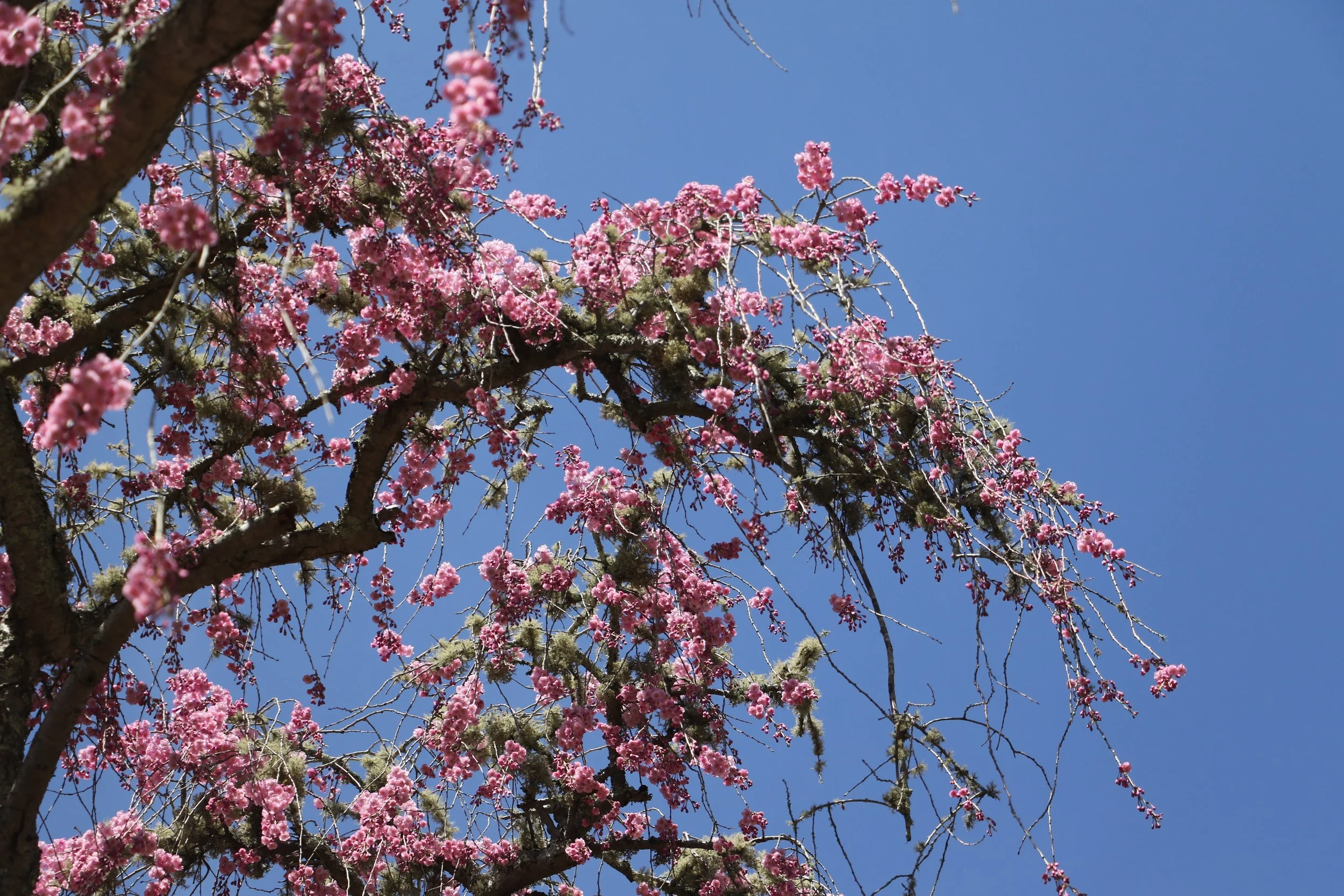
The beautiful combination of beard lichen in its vibrant spring colors standing out against the pink flowers of a weeping Higan cherry (Prunus subhirtella 'Pendula') at Bois Doré arboretum.
As an epiphyte, the lichen is simply attaching itself to the bark on a tree for an environmental advantage, not taking energy from the tree itself as a parasite would. Lichen does not have roots, it instead has a completely different anatomy that I will not go into here. Suffice it to say, lichen attaches itself to its chosen substrate with a variety of its parts that differs between species and type, none of which are made for the transfer of energy. This becomes a bit clearer when we look at everything else that lichen can grow on. Stone, soil, park benches, gravestones, yard cars, plastic play houses, vinyl siding, and, given the opportunity, bones, none of which are providing the lichen any additional nutrients. This list of assorted materials also highlights that lichen has the ability to grow on most anything that holds still long enough. That is the next key to the puzzle.
Last winter, you may have read my article on tree bark exfoliation (Exfoliation: Uncovering the Beauty of Tree Bark in Winter) where I outlined the mechanical, biological, and aesthetic aspects of tree bark cycles. A healthy tree sheds bark as it grows, its expanding circumference cracking and sloughing off the now dead and brittle exterior layers that once made up the living phloem layer. This mechanism helps keep the tree healthy, maintaining healthy bark layers that protect from elemental, mechanical, and pest damage. It also prevents the long term growth of lichen. Any attempt at colony creation is met with its platform literally being ripped away to fall among last year's autumn leaves. That is, of course, if the tree is healthy and growing with vigor.
As trees age or are diminished by disease, insect, or environmental pressures, expansion begins to slow as energy is reallocated from active growth to maintaining the tree's existing structure. A potential ramification of this defense mechanism is dieback that results in a decline in canopy cover; fewer leaves means more sun able to reach branches that are now dead or dying. The combination of halted growth, less bark exfoliation, and an increase in sunlight, provides ample opportunity for lichen to flourish on inner branches that it otherwise might have just puttered along on.
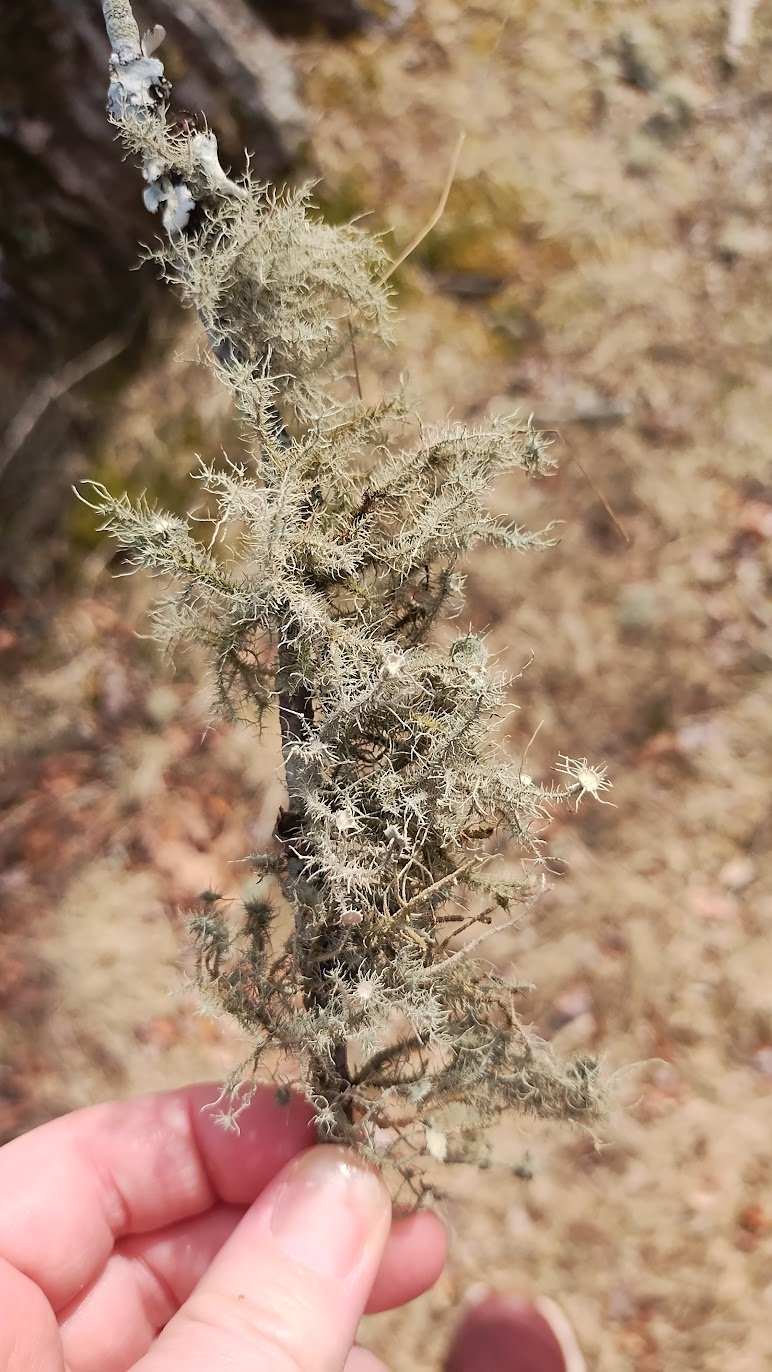
A fallen, dead white oak (Quercus alba) twig covered in a beard lichen (Usnea sp.)
The most common culprit in our area are the beard lichens (Usnea sp.), noted for their gnarled and twisted grey-green tendrils growing in tufts large enough to be seen from a distance. Admittedly, when the otherwise smooth silhouette of a tree is disrupted by thick patches of this lichen, it does evoke a certain eerieness, a feeling perpetuated by spooky stories taking place in decrepit, fog-filled forests. Now, when we have a tree that sheds dead, beard lichen covered branches and twigs with every wind storm, it may be easy to see the lichen and blame it for your beloved tree's decline. But correlation does not imply causation. The lichen, just as any other living thing, is taking advantage of ideal conditions and thriving with the opportunity. And yes, part of those ideal conditions here on the coast, is generally good air quality. Lichens can be sensitive to air pollution, but with over 14,000 species, there is a variety of tolerances to varying pollutants, some consistent enough that they are used as indicators in scientific studies on air quality. The beard lichens we see here are typically considered quite sensitive to air pollution, and would not be as robust in areas with contaminated air.
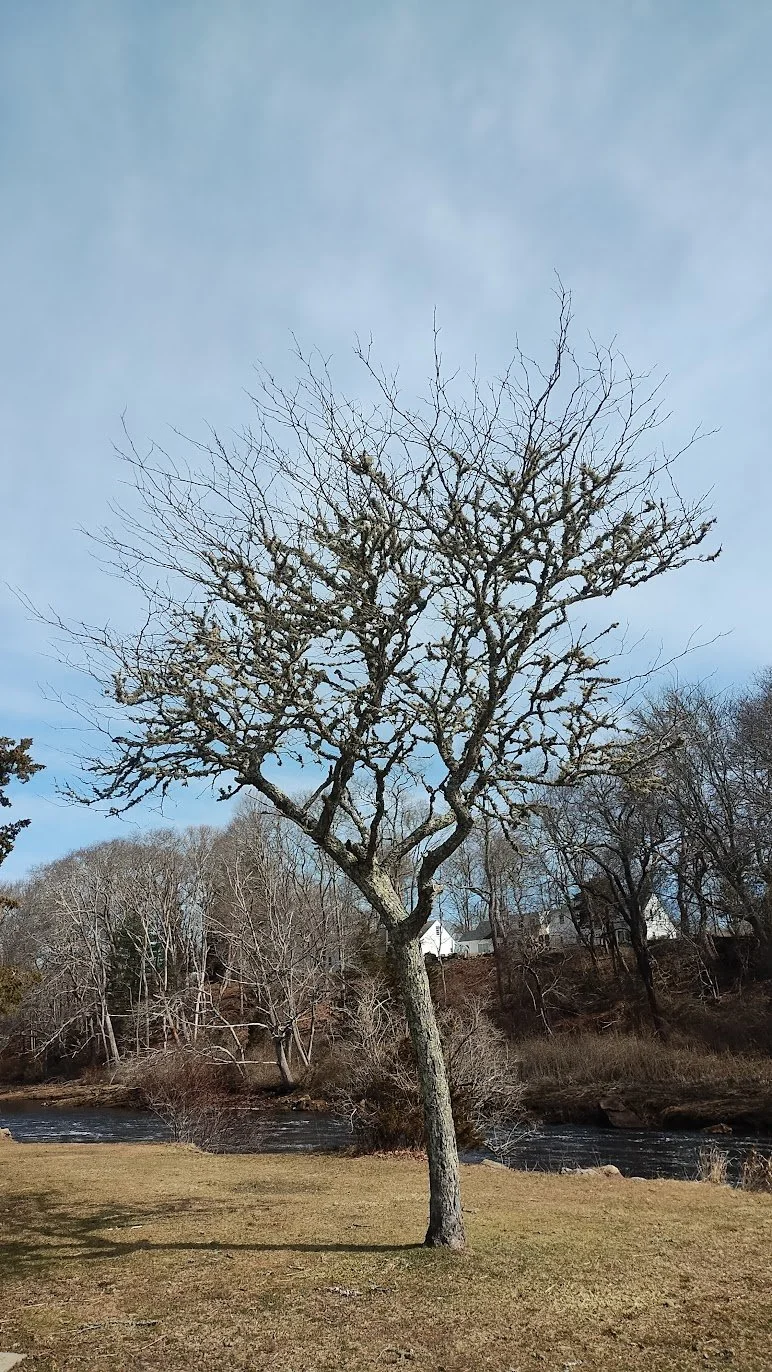
A tree exhibiting the stark difference between lichen covered, slower growing branches, and the clean, vigorous tree growth on the top of the tree.
What does this all mean for the health of a tree? First, note that lichen also grows in all shapes and sizes on perfectly healthy trees, and you'd be hard pressed to find a tree completely free of it. If you do have large quantities of beard lichen on a tree in your yard that is causing you concern, look at the tree itself and see if there is anything you can do for it. Has it been shaded out by another tree? Is the soil on its roots too compacted? Does it need supplemental water during drought times? Are there pest or disease problems that have been too subtle to notice otherwise? There is, of course, a chance the tree is reaching the end of its lifespan, as can be seen with some shorter-lived flowering trees. Or, like so many oaks here, the tree may have suffered from a few rough years of pests and drought leaving evidence of dieback in the form of fuzzy, lichen covered branches. Removing the lichen is also not necessary and could damage the tree in the process.
While easily overlooked, the tiny world of lichens is large and varied. These amazing microecosystems have existed on Earth since plants first began their move onto land over 400 million years ago. Lichen has become a food source, form of shelter, and a tool for all sorts of land, air, and arboreal critters. Beard lichens can be found delicately woven into birdsnests, and shield lichens carefully wrapped around the tiny nests of hummingbirds, protecting the minute eggs within from prying eyes. On each species of tree, a new combination of lichens can be seen, all finding an ecological niche even within the confines of a single tree. With longer days able to shine on the lichen with no leaves to shade it, and the return of moisture to the air rehydrating dried species to bring out more vibrant colors, spring is the perfect time to appreciate lichen’s unusual beauty and unappreciated ubiquity.
By Morgan Palmer, Plant Production Manager
Sources
Colesie, Claudia, and Kevin K Newsham. “Lichens as Biomonitors of Air Quality and Climate.” Global Change Biology, U.S. National Library of Medicine, 23 Feb. 2026, pmc.ncbi.nlm.nih.gov/articles/PMC12926855/.
Fornari, C.L. “Is That Fuzzy Moss Killing My Trees?” Hyannis Country Garden, 15 Nov. 2021, www.hyanniscountrygarden.com/is-that-fuzzy-moss-killing-my-trees/.
Walewski, Joe. Lichens of the North Woods. Kollath+Stensaas Publishing, 2023.