
Francesca: A Rhode Island Rhododendron
- An Introduction to the Growers and the Growee –
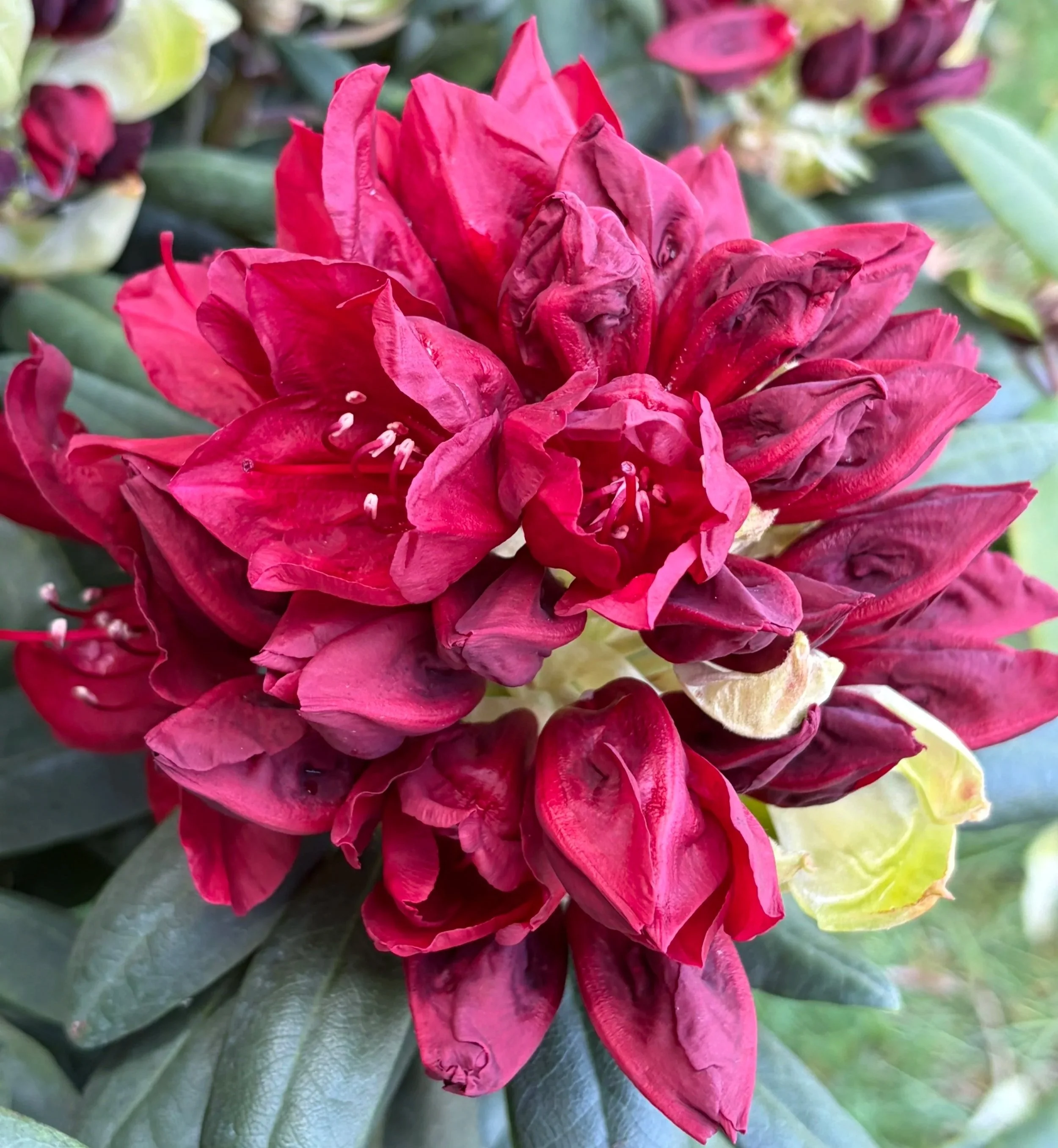
Of all the historic growers that have worked the fertile land of Rhode Island, perhaps none have a more interesting and storied legacy than Bald Hill Nurseries and the people who contributed to its success. The foundation of the company, 5 brothers with no formal training in horticulture, worked hard to create one of the largest nursery operations in the northeast. The story writes itself. Opening for business in 1947, the brothers learned to grow plants completely by trial and error, observed and recorded in detail, and over time became significant pioneers in the nursery industry. The five Savella brothers, children of Italian immigrants, consisted of Leonard, Angelo, Albert, George, and Henry. Despite being stalwarts in the field of woody plant propagation and growing plants from seed, they only introduced one unique plant or clone into commerce. That single plant, named in honor of their beloved mother, is a breathtaking rhododendron planted near and far for its sumptuous red flower.
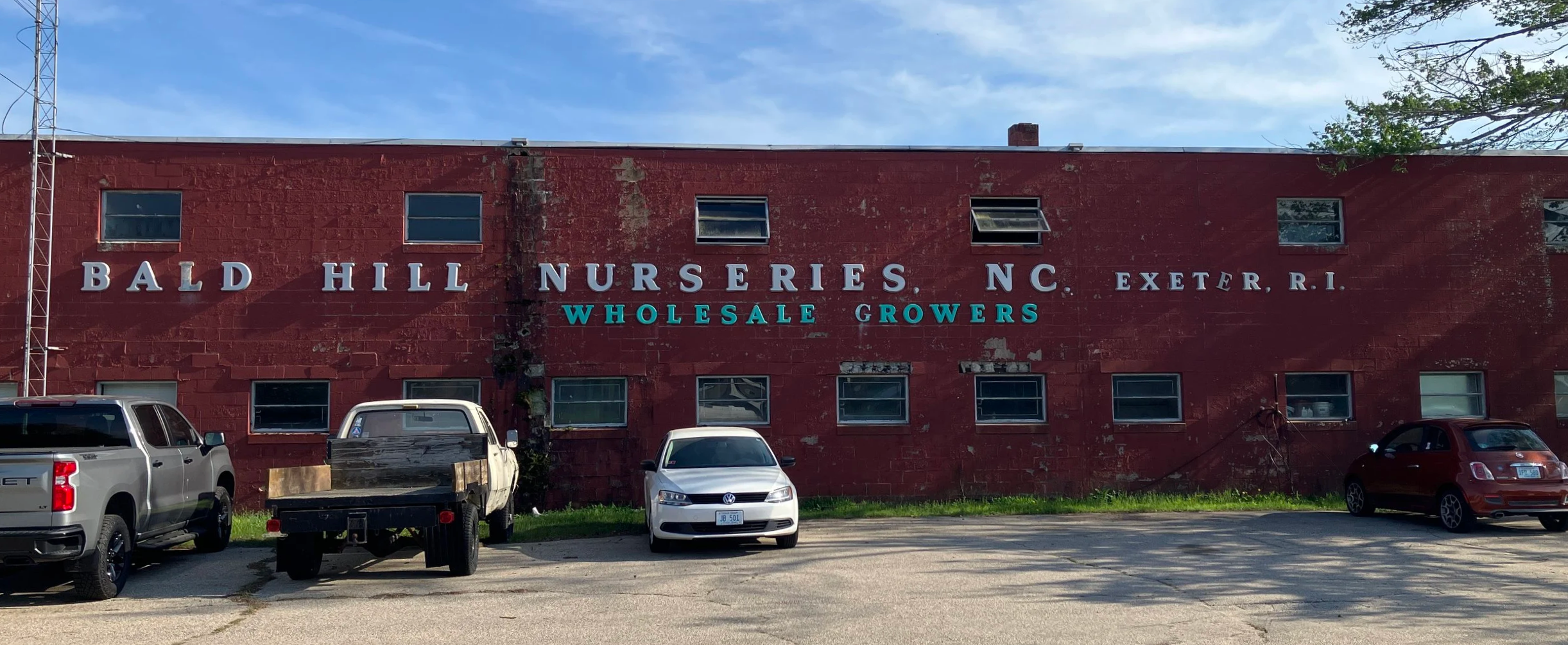
The still-occupied office building at the former sales yard of Bald Hill Nurseries on Ten Rod Road in Exeter, R.I.
‘Francesca’ is one of several rhododendrons and azalea varieties to be selected and named in the state of Rhode Island. I’m currently in the process of recording a growing list of around a dozen named selections of Rhododendron, several of them registered with a cultivar registration authority. These plants have resulted from several passionate plantspeople representing Kinney Azalea Gardens, the University of Rhode Island, Hoogendoorn Nurseries, Van Hof Nurseries, and Portsmouth Nurseries, in addition to Bald Hill. Out of all of “Rhody’s Rhodies”, the blooms of ‘Francesca’ are described with the most intense imagery. Its captivating rich burgundy or “blood red” color, large prominent trusses, and impressive mature size make for a garden standout; a plant capable of causing mass hysteria. ‘Francesca’, or “Franny” as some people affectionately call her, will grow moderately fast under standard growing conditions, reaching 6 feet tall and wide in only 10 years. Like other rhododendrons, it grows best in moist but well-draining, acidic soil and preferably under partial shade. Reports indicate that the shoots are cold hardy to -10ºF. Growers familiar with the plant are quick to point out that it only retains foliage from the last 2 growing seasons, so it tends to look a little straggly without training. This characteristic is true for many cultivars that have genes from the red-flowered, Himalayan native tree rhododendron (R. arboreum). However, if you break off the terminal buds as growth ensues, it will force more lateral shoots to grow with shorter internodes, thus giving a ‘Francesca’ in a 10-gallon pot a nice dense shape. ‘Francesca’ is described as rooting reasonably well from cuttings, and it can also be grafted. Although Bald Hill Nurseries closed in 2009, ‘Francesca’ continues to be sold in nurseries around the country.
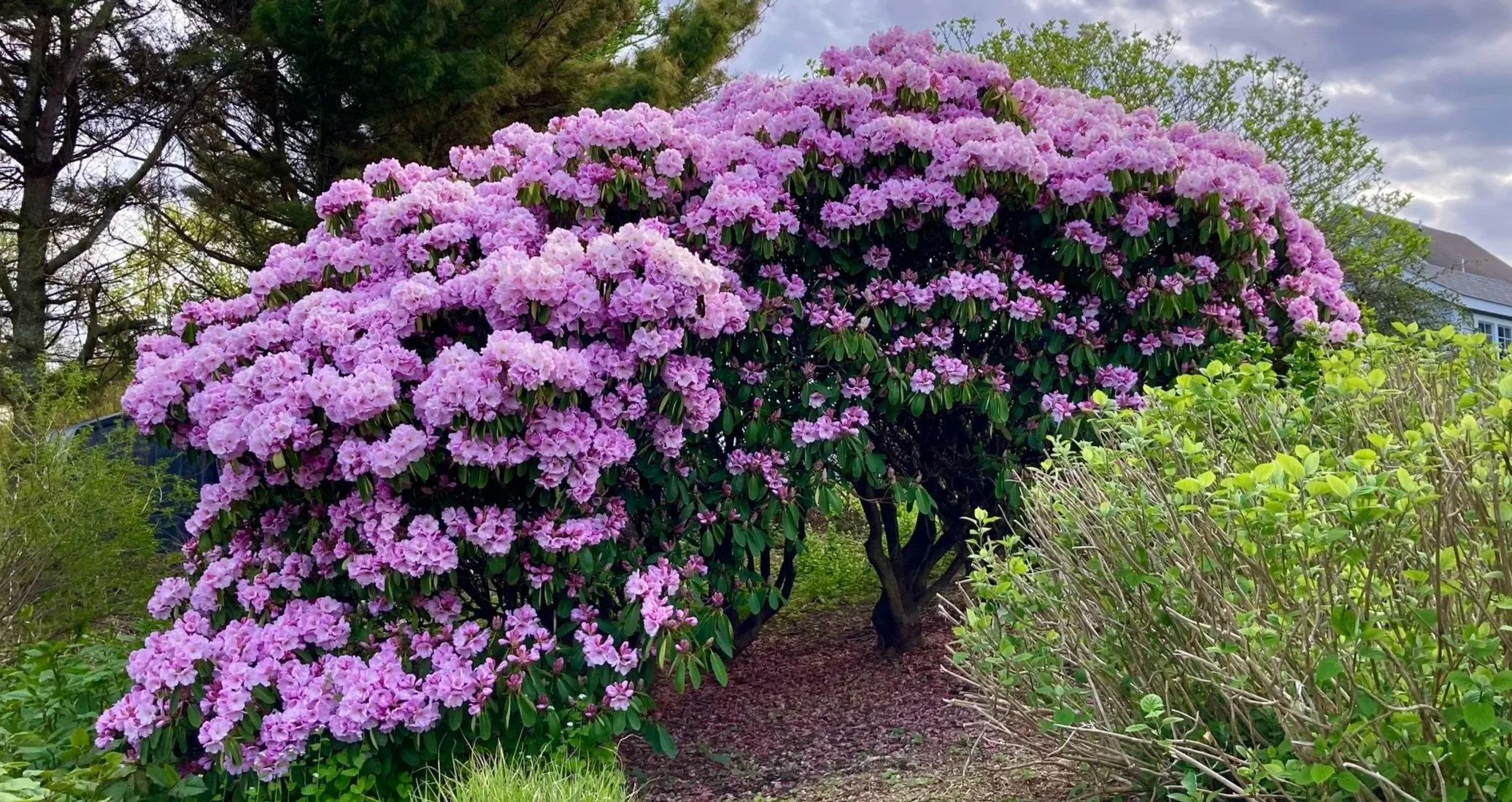
R. ‘Mario Pagliarini’, named and introduced by URI Professor emeritus John Maguire in honor of a Rhode Island Nurseryman – Photo Credit: Bill Johnson
- A History of ‘Francesca’ -
The most complete account regarding the history of ‘Francesca’ was written by Dr. Dorothy G. Swift (see references), a local horticulturist, biologist, and rhododendron breeder. A lifelong teacher and research scientist, Dorothy was active as both a member of the American Rhododendron Society, and the Rhode Island Wild Plant Society. Unsurprisingly, there is Rhododendron ‘Dorothy Swift’, (R. smirnowii x R.degronianum spp. yakushimanum), bred by UConn professor emeritus Gustav Mehlquist and named in Dorothy’s honor.
Dorothy Swift 1939-2025 Photo Credit: Rhode Island Wild Plants Society
According to Swift, ‘Francesca’ was the result of a controlled cross made by Antonio “Tony” Consolini, once an estate gardener at Shawme Farm in Sandwich, Massachusetts. Not much public information is available on Consolini, but for many years he worked as the head gardener at the home of textile manufacturer Charles O. Dexter. Working closely with Dexter, Consolini would grow hundreds of thousands of seeds and seedlings that would be exchanged with growers, gardeners, and friends around the country. Over the years, countless plants both procured and propagated would end up on the grounds of Dexter’s home, building the foundation of over 10,000 rhododendrons that exist in the garden today. At present time, Dexter’s garden is preserved as the non-profit organization, Heritage Museum and Gardens, which allows the public to enjoy the horticultural efforts of many people associated with this historic landscape. The Rhododendrons propagated by Dexter, Consolini and later other horticulturists are known as the Dexter hybrids (sometimes as the Fortunei hybrids, as R. fortunei was the primary species used in the crosses) and constitute one of the most beautiful yet confused hybrid groups of Rhododendron originating on American soil. Swift writes that Consolini’s home garden was full of numerous plants he had propagated from the estate’s collections. It is likely from these plants that Consolini performed the controlled cross that would result in the birth of ‘Francesca’.
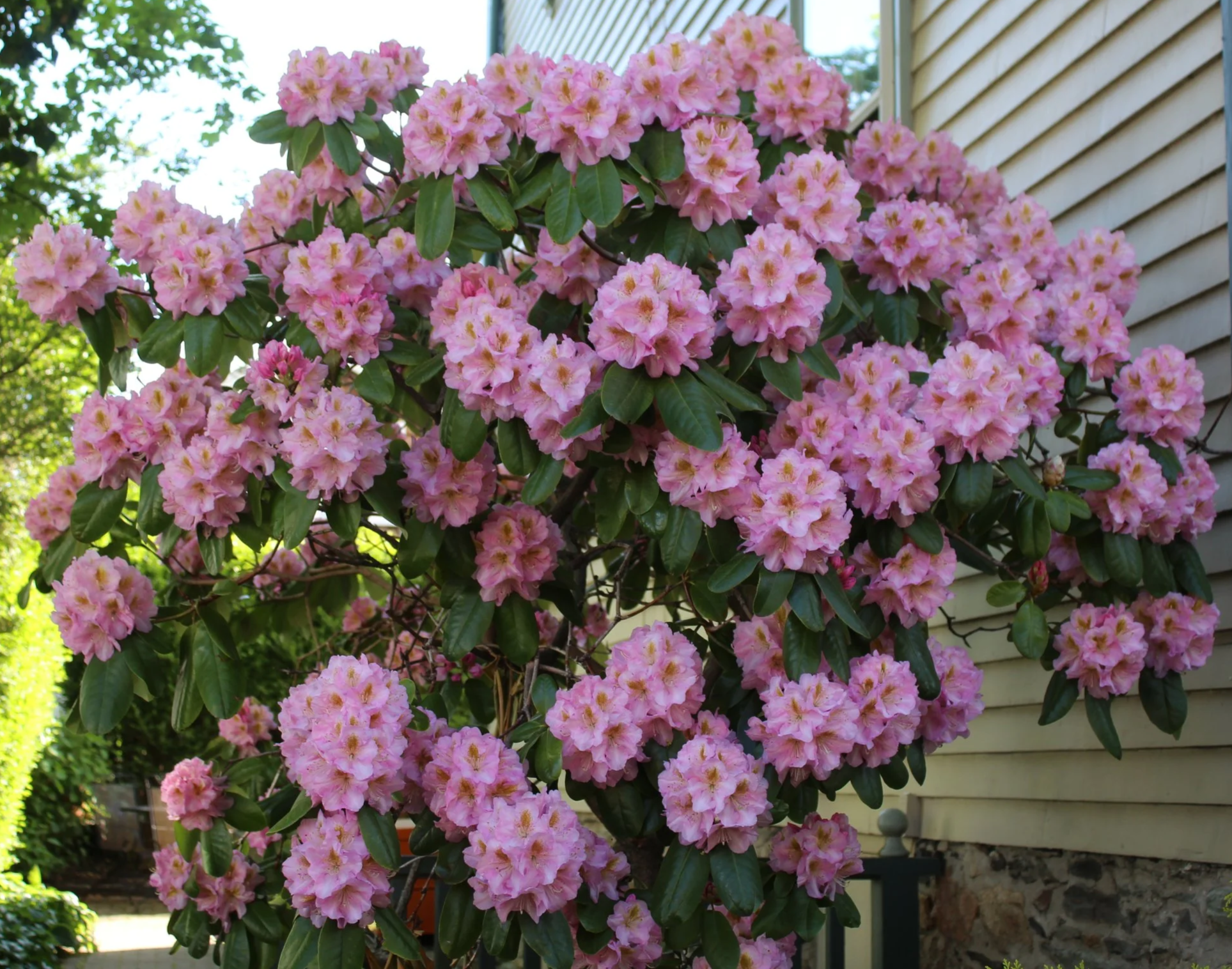
The most common Dexter hybrid in cultivation, R. ‘Scintillation’, blooming in a Newport Garden.
At some point in the 1950s, the Savella Brothers from Bald Hill Nurseries purchased several seed lots from Consolini and grew the seedlings they managed to germinate. According to Swift, a plethora of beautiful and variable plants resulted, and were planted in tight rows at the nursery’s North Kingstown, RI property. It is from this group of plants that ‘Francesca’ was selected by the brothers, who often argued over the quality of the seedlings, but all agreed the dark red form was special enough to be named in honor of their mother. The brothers would then register and patent the plant, a formality that was unusual for rhododendrons at the time. Consolini is said to have had an interest in red flowers, so it’s no shock he gifted a glorious red to the Savella brothers. The pollen and seed parents of ‘Francesca’ are listed as being R. ‘Britannia’ a Dutch hybrid with good red color, and R. ‘Dexter 202’, a numbered seedling with unknown characteristics to this author, respectively. Angelo Savella is listed as having introduced the new hybrid into cultivation in 1960.
I was fortunate enough, despite it being a busy spring day, to speak with nurseryman Bob Aube, the man who everyone I spoke with regarding ‘Francesca’ told me I needed to talk to. Bob is the nephew to the late Albert Savella by marriage and spent the 1980s working for the Savella brothers at the wholesale yard on Ten Rod Road in Exeter. He would later work as the Bald Hill Garden Center manager on the retail side of the business, before breaking off to start Morningstar Nurseries, a successful wholesale nursery operation. One of several interesting things Bob brought up during our conversation was Angelo Savella’s direct role in the hybridization work that resulted in ‘Francesca’. This, of course, somewhat contradicts Dorothy Swift’s account of Consolini performing the hybridization tasks solo. However, Bob’s statement is further backed up by another former Bald Hill nurseryman, Ronn St. Jean. Ronn was well aware of Angelo’s involvement in the rhododendron project, and at some point, read through his notes that indicated the parentages and cross details that correlated with each seed lot. Bob acknowledges that Consolini was involved as well, but unfortunately, he did not know who played what specific role in the creation of this beautiful plant. We must speculate a little bit, but I think it’s safe to say that Angelo Savella was at the least privy to the specific controlled crosses being made and probably had a hand in the action as well, be it collection of pollen (stamens), performing crosses, or collecting the resulting seed.
- The Quest for Blooms, and some other R.I. Rhododendrons -
To get a better understanding of ‘Francesca’, I reached out to my friend Dr. Susan Gordon, rhododendron expert and longtime horticulturist at Kinney Azalea Gardens in Kingston, RI. I was eager to see ‘Francesca’ in flower, and I figured the most complete rhododendron collection in the region would have a resident accession. During an April visit to the garden, Sue and Kinney Interpretive Horticulturist Johnathan George would lead me to a rather unexcited ‘Francesca’ clone in the shade of other large rhododendrons. Unfortunately, there were no flower buds set for the May ahead. Turning a positive, I thought to myself; it shouldn’t be this easy anyway. It’s only fitting I’ll need to overcome adversity to earn the privilege of witnessing the legendary red blooms. Sue was able to show me two other Rhode Island rhododendrons, ‘Pioneer Silvery Pink’ from Hoogendoorn Nurseries in Middletown, and ‘Snow’s Red’ from Van Hof Nurseries, formerly of Portsmouth. ‘Pioneer Silvery Pink’ (R. racemosum x R. mucronulatum) is a lepidote (small-leaf), evergreen rhododendron with attractive foliage and clear pink flowers in late April/early May. It was discovered as a chance seedling of R.‘Pioneer’ and selected by Case Hoogendoorn. ‘Snow’s Red’ was selected by Bob Van Hof, named in honor of a grower on Cape Cod, and grown by Van Hof Nurseries. It was never registered or widely distributed. Its parentage is unknown to this author, but it is another spectacular red. It should be noted that ‘Pioneer Silvery Pink’ was in full bloom on April 29th, and ‘Snow’s Red’ had a handful of fully open flowers on May 21st .
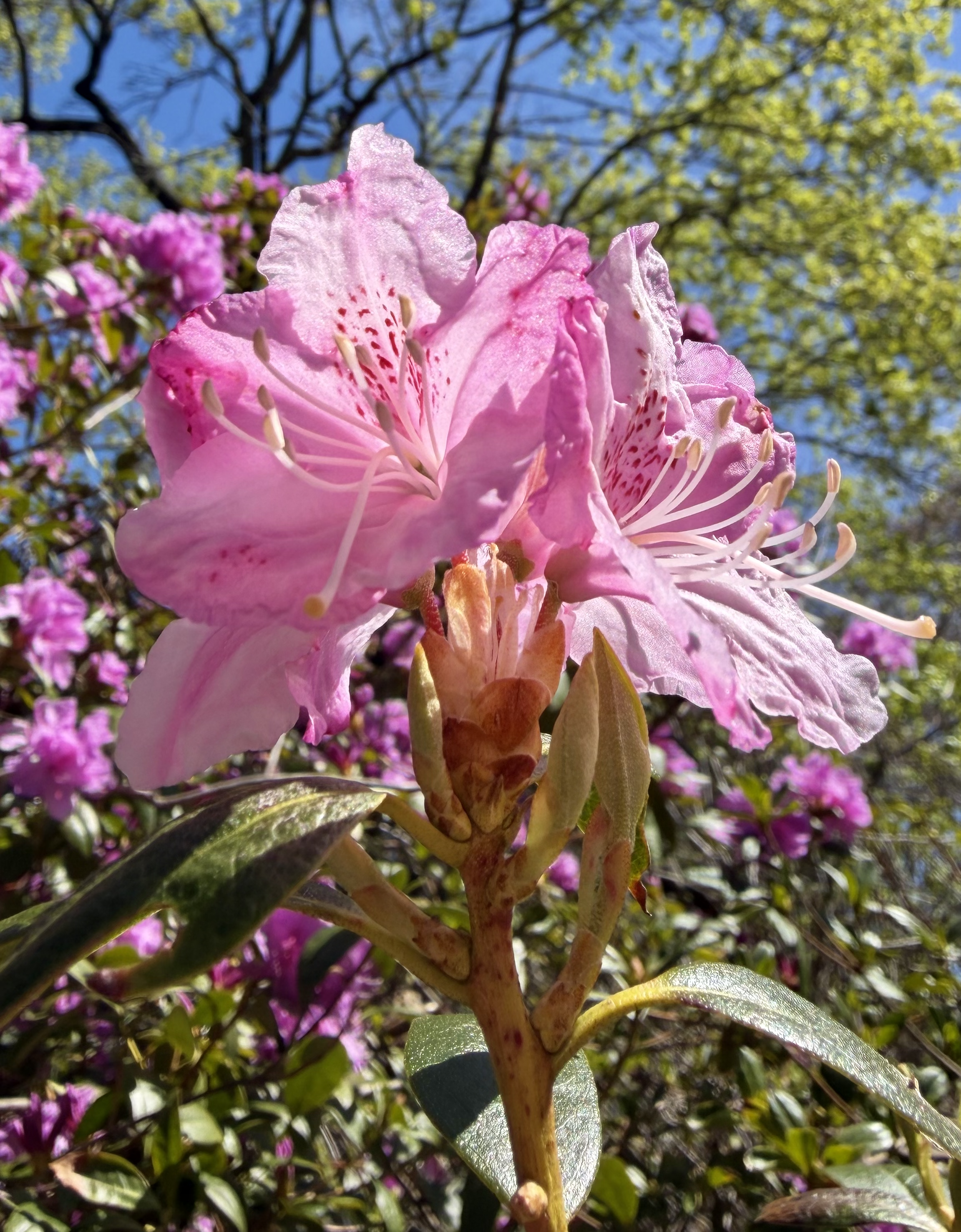
R. ‘Pioneer Silvery Pink’, introduced by Hoogendoorn Nurseries in Middletown, RI. Photo Credit: Abby Snoeren Place
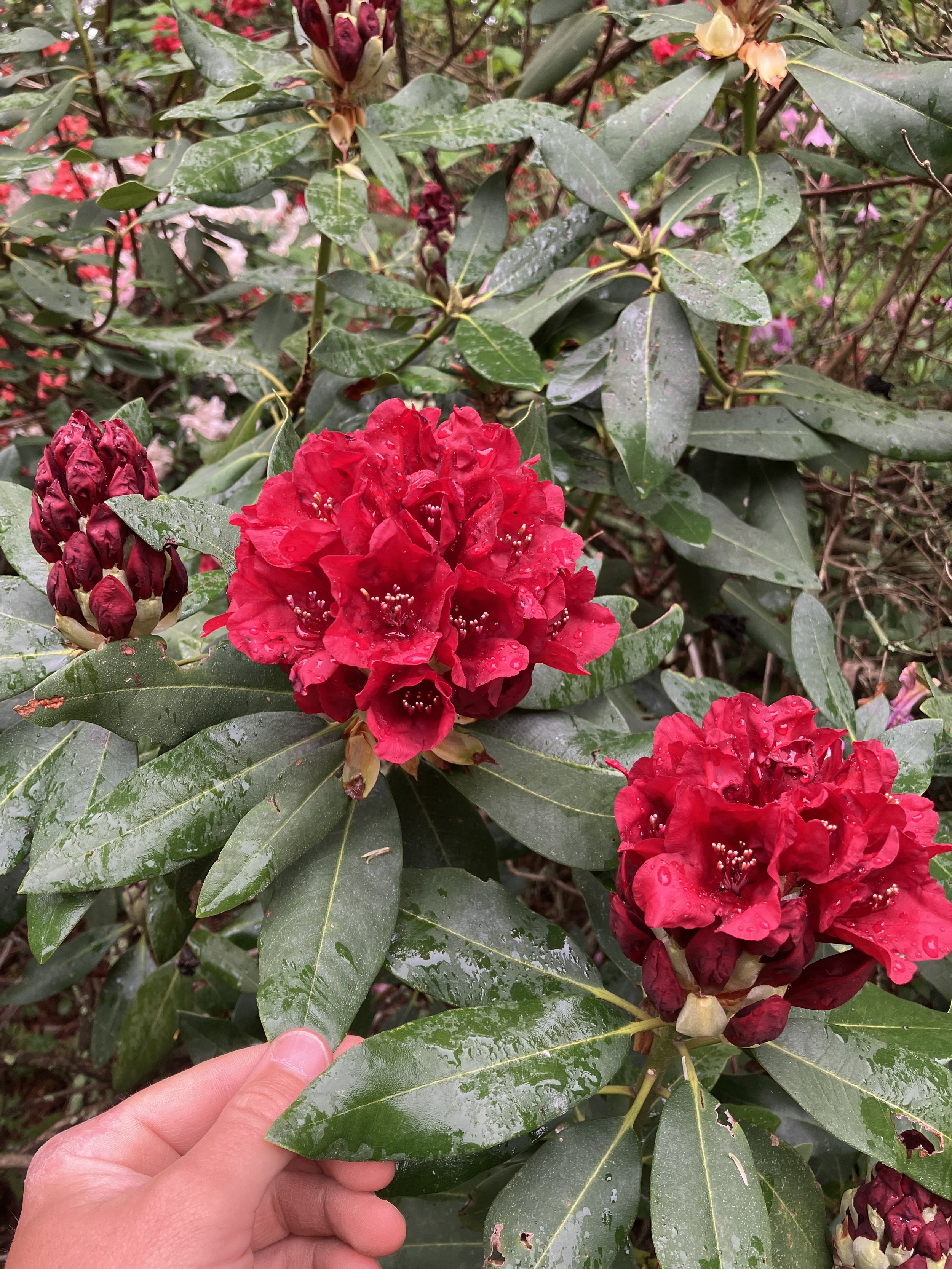
R. ‘Snow’s Red’, selected at Van Hof Nurseries and blooming in Kinney Azalea Gardens.
Sue mentioned during my visit that Summer Hill Nurseries in Madison, Connecticut, which supplies the container stock available at Kinney, had ‘Francesca’ available for wholesale purchase. I rang the nursery, but they kindly told me they were sold out of ‘Francesca’ but had more in production that would be available soon. Tough, but it’s nice to hear the plant is being propagated and traded close to home. Fueled with speculation and curiosity, I decided to venture over to Forest Hills Nursery in Cranston to see what they had available. Forest Hills, which has been in business since 1928, was a nursery in friendly competition with Bald Hill for several decades. Today, they are a well-stocked retail/wholesale nursery business specializing in a host of landscape plant materials, located right in the heart of commercial Cranston on Route 2. Upon arrival, I was lucky enough to run into Nursery Manager Matthew Grimes, who stopped over to check in as I wandered like a lost puppy through the densely packed sales yard. Matt proudly told me that ‘Francesca’ was available, and led me to several bushy plants, loaded with healthy flower buds. What a fantastic discovery! It turns out that Forest Hills’ owner Alan Muoio was related to the Bald Hill brothers through marriage. Alan and Matt continue to supply ‘Francesca’ to honor the connection between the families and the two historic Rhode Island nurseries. “This is where people come to find Francesca”, Matt told me. I ecstatically purchased two plants, relieved in knowing I wasn’t going to miss the blood red flowers of ‘Francesca’ this spring.
- Serendipity –
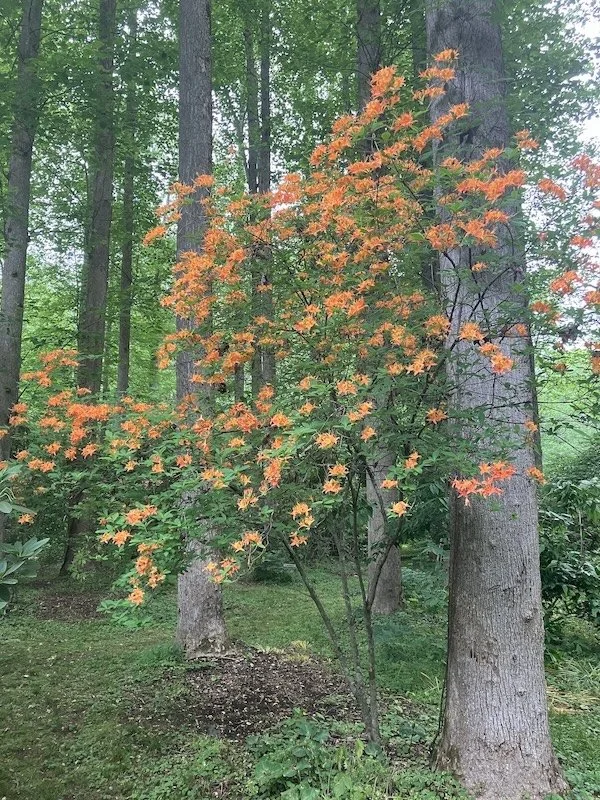
R. calendulaceum and its beautiful orange flowers in the garden of Jane and Boris Bauer
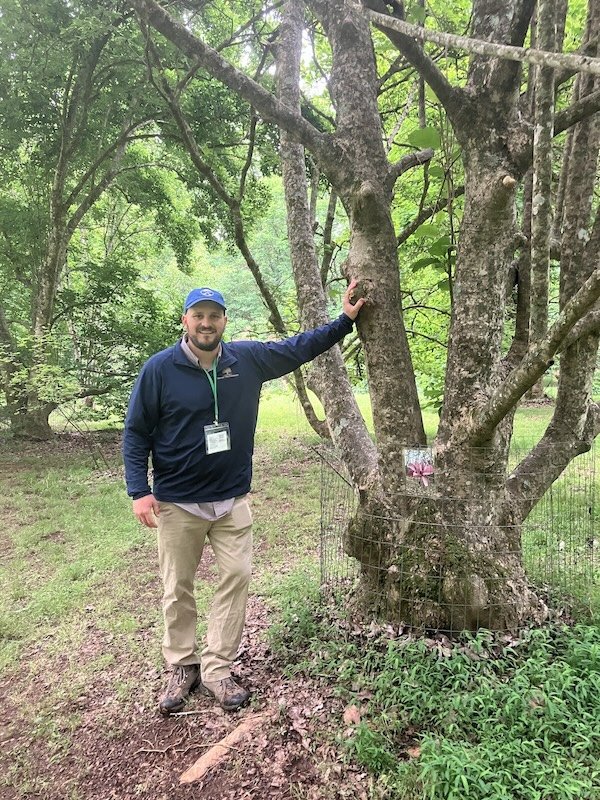
The author standing next to a large Magnolia ‘Galaxy’ in Easley, SC.
In early May, just as the first flower buds on our ‘Francesca’ plants were starting to show some color, I left Rhode Island and the early spring of the northeast, to the summery mountain landscapes of southern Appalachia. I was to spend a couple days with the Magnolia Society International, visiting a slew of gardens, universities, and arboreta in both North and South Carolina, where great horticulture was taking place. On the morning of May 9th, the group visited the home garden of Jane and Boris Bauer, located in Easley, South Carolina. While we were there primarily to study and enjoy the nearly 200 different magnolia taxa, it was impossible to ignore the quiet presence of an impressive rhododendron collection. While most rhododendrons and azaleas had finished blooming in this South Carolina floodplain, native deciduous azaleas such as the flame azalea (R. calendulaceum) were in full regalia. As I began tracking back from the river’s edge, I noticed a straggly rhododendron under the shade of mature tulip trees. The flowers were past prime, but the red color stood out boldly in the rich green landscape. I walked towards it and wondered…could it be, nearly 1000 miles from home? A little metal tag confirmed the extraordinary – it was the great ‘Francesca’, and still in bloom! It would be my first time knowingly witnessing ‘Francesca’ in flower.
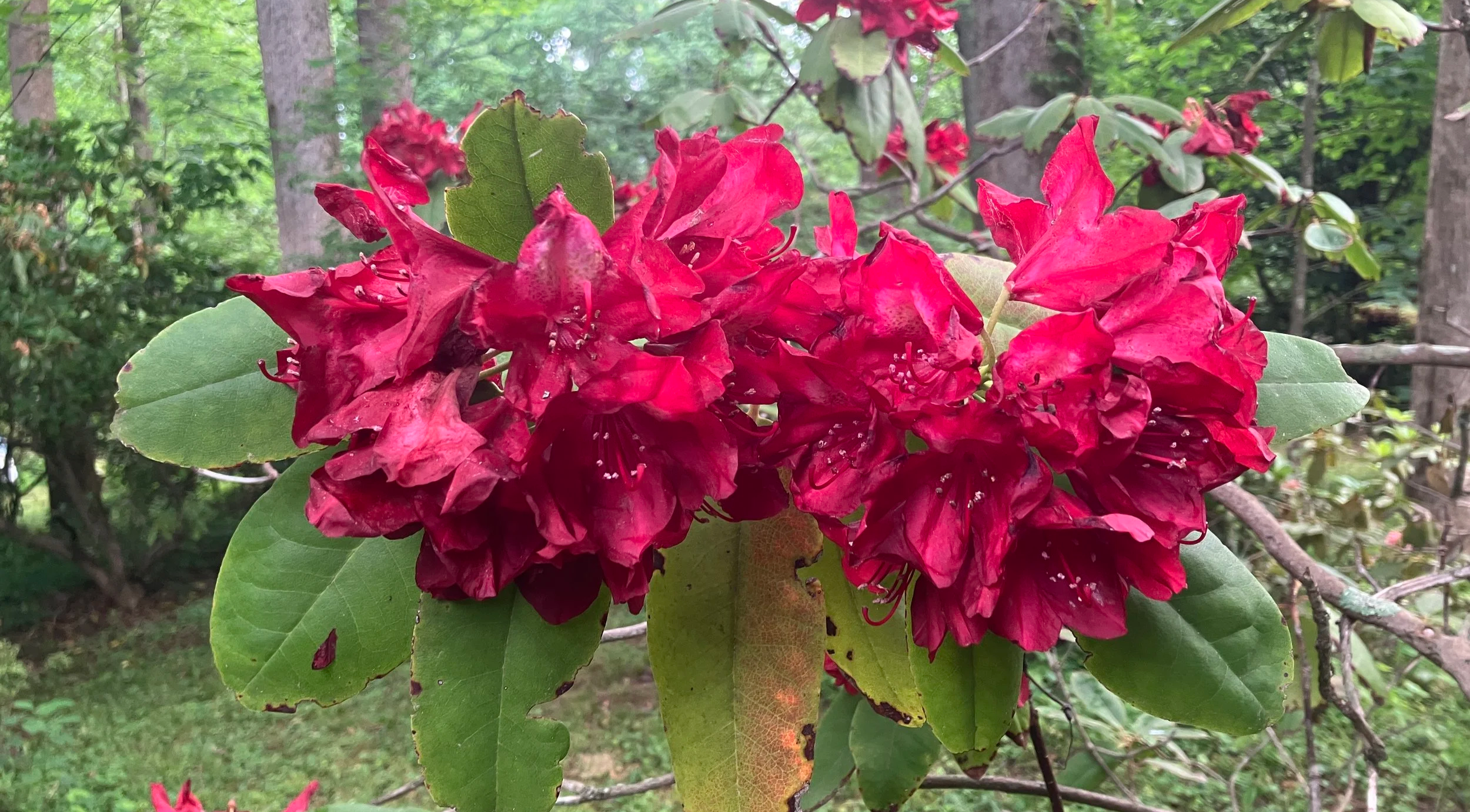
The first photograph the author took of ‘Francesca’ in flower.
Later that day, I was able to speak with Boris briefly about his garden and what he knew about ‘Francesca’. Involved with the American Rhododendron Society (ARS) since the early 1980s, Boris collected an astonishing 400 rhododendrons and azaleas on his 4.4 acre suburban property in Zone 7B. He told me he received his ‘Francesca’ from an ARS plant exchange and also commented on the (incorrect) fact that ‘Francesca’ was the first patented rhododendron. Another rhododendron expert at the meeting, Ron Rabideau, was also quick to point out the product protection associated with ‘Francesca’ when I mentioned my interest in the cultivar. It appears the shrub being patented really resonated with rhododendron folks. Since most rhododendron cultivars aren’t patented, ‘Francesca’ requiring additional monetary hurdles in order to grow and sell, for better or worse, is memorable. Plant patents are only good for 20 years after the filing date, so ‘Francesca’ can now be propagated freely. When I asked how rhododendrons performed in his garden, Boris told me the elepidote (largeleaf) rhododendrons shoot up fast and bloom well, but do not endure the southern heat and are quick to perish. Still, ‘Francesca’ might be worth an attempt if you garden in the mountainous regions of Appalachia, anywhere the mountain laurel flourishes in the shade of sweetgum, maple, and tulip poplar.
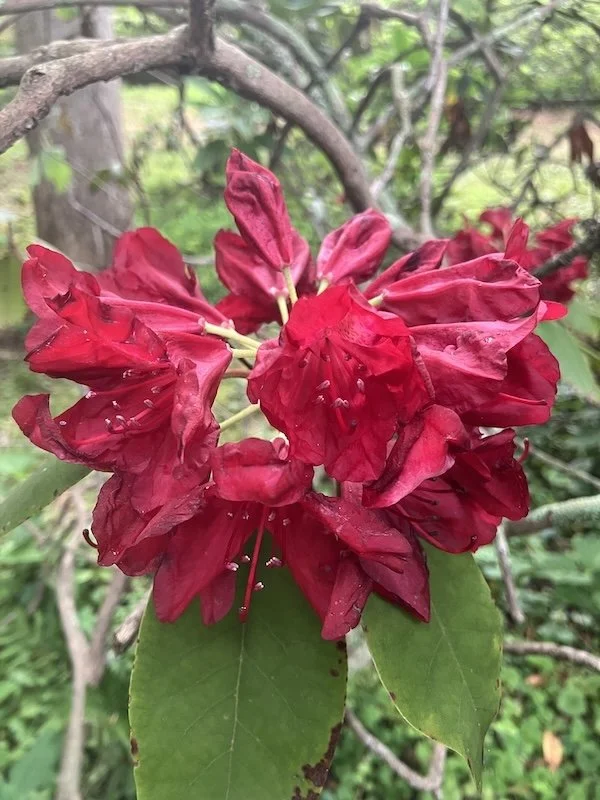
The nearly finished flowers of ‘Francesca’ in the Bauer’s garden
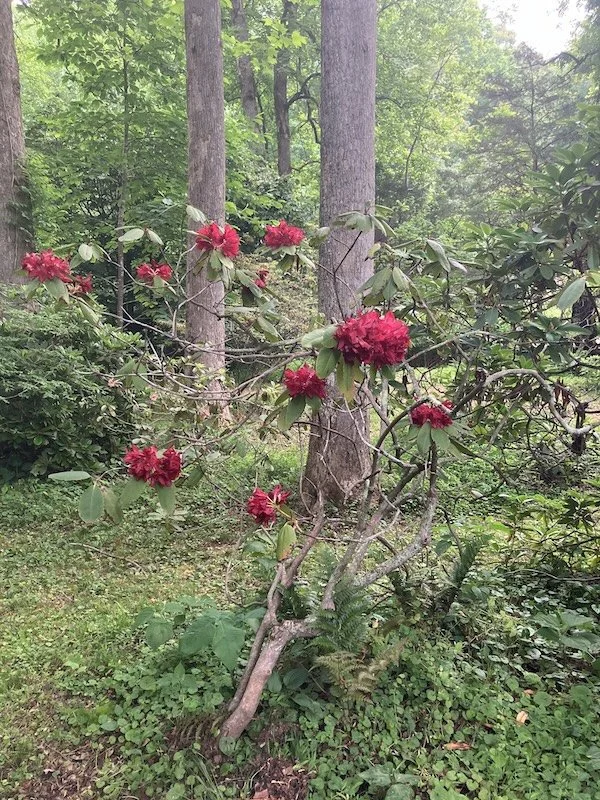
The Bauer’s straggly ‘Francesca’ shrub, with mature tulip trees in the background.
- Where it all Began -
All while doing research into the history of Bald Hill Nurseries and ‘Francesca’, I always queried the possibility of visiting the location where the Savella brothers raised their diverse array of rhododendron seedlings, described by Dorothy Swift as tightly packed rows planted much too close. Hort friends with hands-on experience with these plants told me some of the brother’s rhododendron hybrids still grew on site, accessible yet guarded. It turns out the nursery field where the brothers grew rhododendrons for evaluation and as stock plants for propagation was converted into a housing development in 1990. Amazingly, much of the diverse stock, not limited to rhododendrons, was retained during the construction of the roads and houses. However, these plantings are located on private property, and with time, these unrecognized pieces of horticultural history are lost to cultivation. I wasn’t expecting to find the original ‘Francesca’ or anything of that nature, but I had a gut feeling it would be important for me to go. So, on a day in late May I believed ‘Francesca’ might be blooming that brilliant red, I made the trek down. I will keep the location of these plants a secret, although with a little digging it shouldn’t be hard to find.
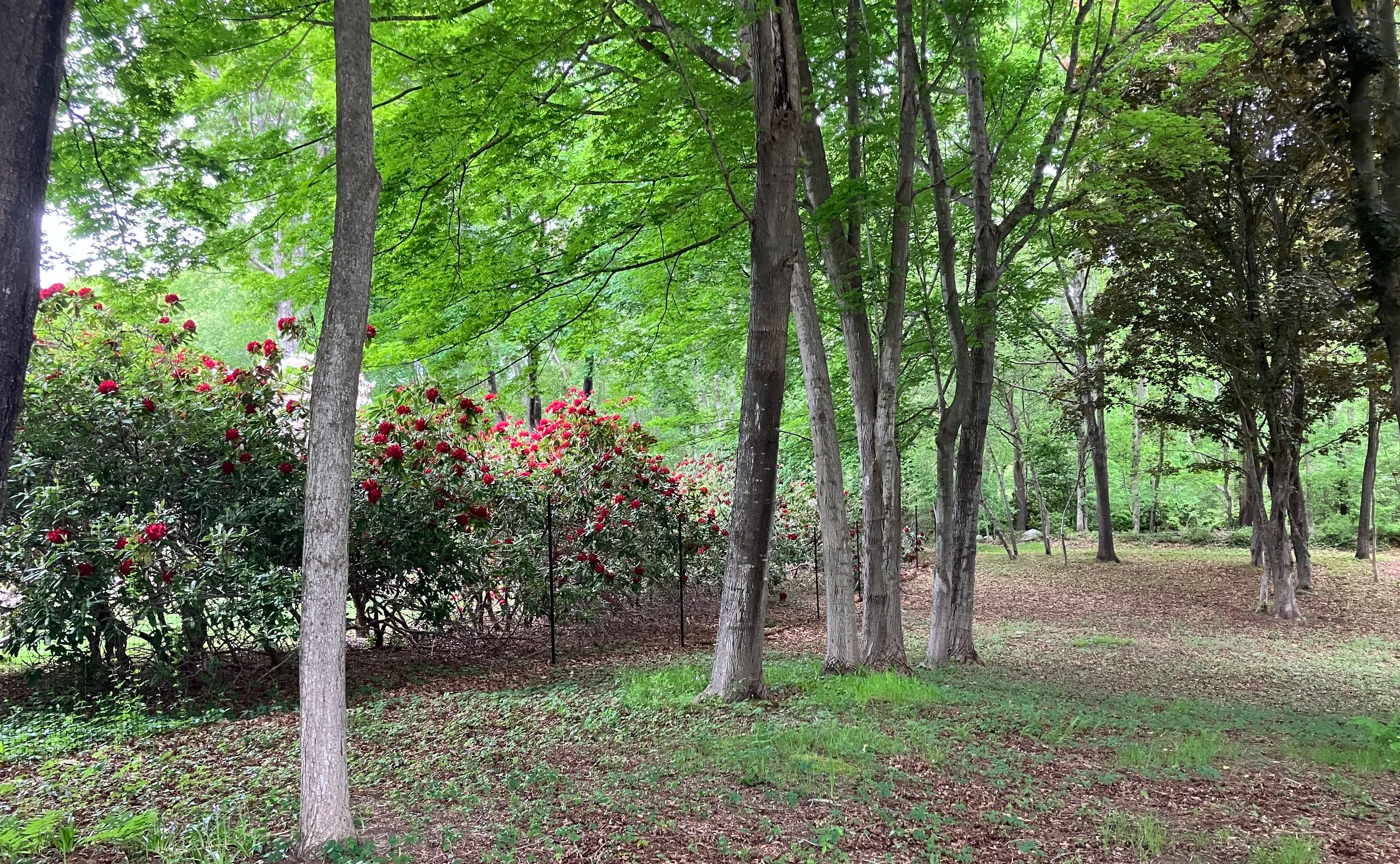
Old nursery stock rows of maple trees retained during the construction of the neighborhood.
Right as I entered the lush neighborhood, it became apparent that rhododendrons grew magnificently here. Passing by large houses and expansive lawns, I noticed rhododendrons by the hundreds, with blooms of pink, purple, and white shades amongst the dense shrubbery. Even some yellow and cream-colored flowers announced their presence. After slowly cruising along for a couple minutes, I noticed some tall blooming shrubs behind a deer fence to my right. I passed by, turned the car around, then parked with the rhododendrons in full view. I couldn’t believe my eyes. In front of me was a massive hedge, composed mostly of (true) red flowered rhododendrons, with some additional white/pink flowered types plopped in the middle. The planting stretched the entire eastern border of the property (crossing the street as well), and it was in peak bloom! Closely examining the individual plants, the flower color and markings (throat spotting) were all the same on the red-flowered types. Looking at the group from a distance, every individual had a perfectly synced floral anthesis. Without surprise, the shaded plants at the end of the row had rather lanky growth habits, but the leaf characteristics remained the same on all the individuals I inspected. Grinning from ear to ear, I knew it had to be ‘Francesca’. One interesting thing I’ve noticed observing these ‘Francesca’ in bloom, is that as the flowers age, the outside of the corolla will become more magenta in tone. This is due to pigment dilution as the flower expands, and photo-oxidization as the flowers senesce. But, when the flower is freshly open, the color is so very near to a true red.
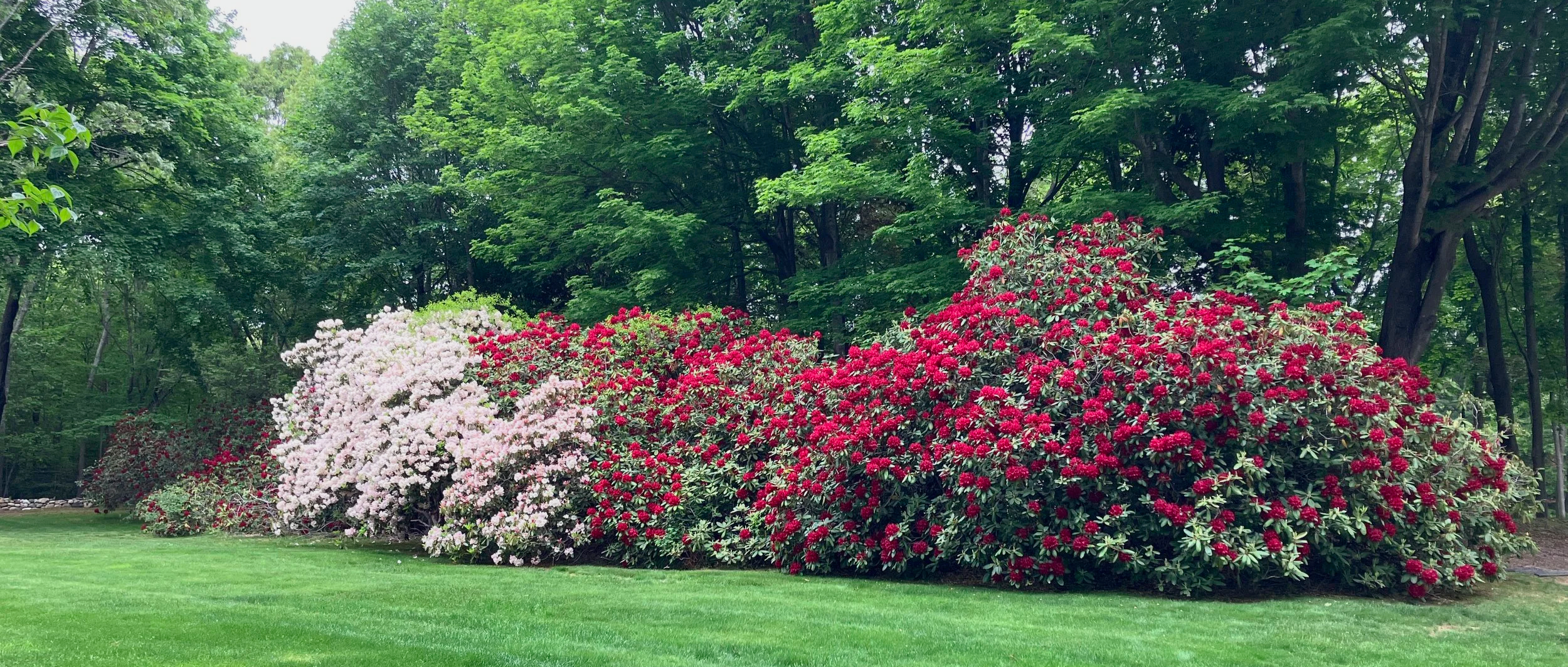
A long block of mature ‘Francesca’, planted by the growers at Bald Hill Nurseries
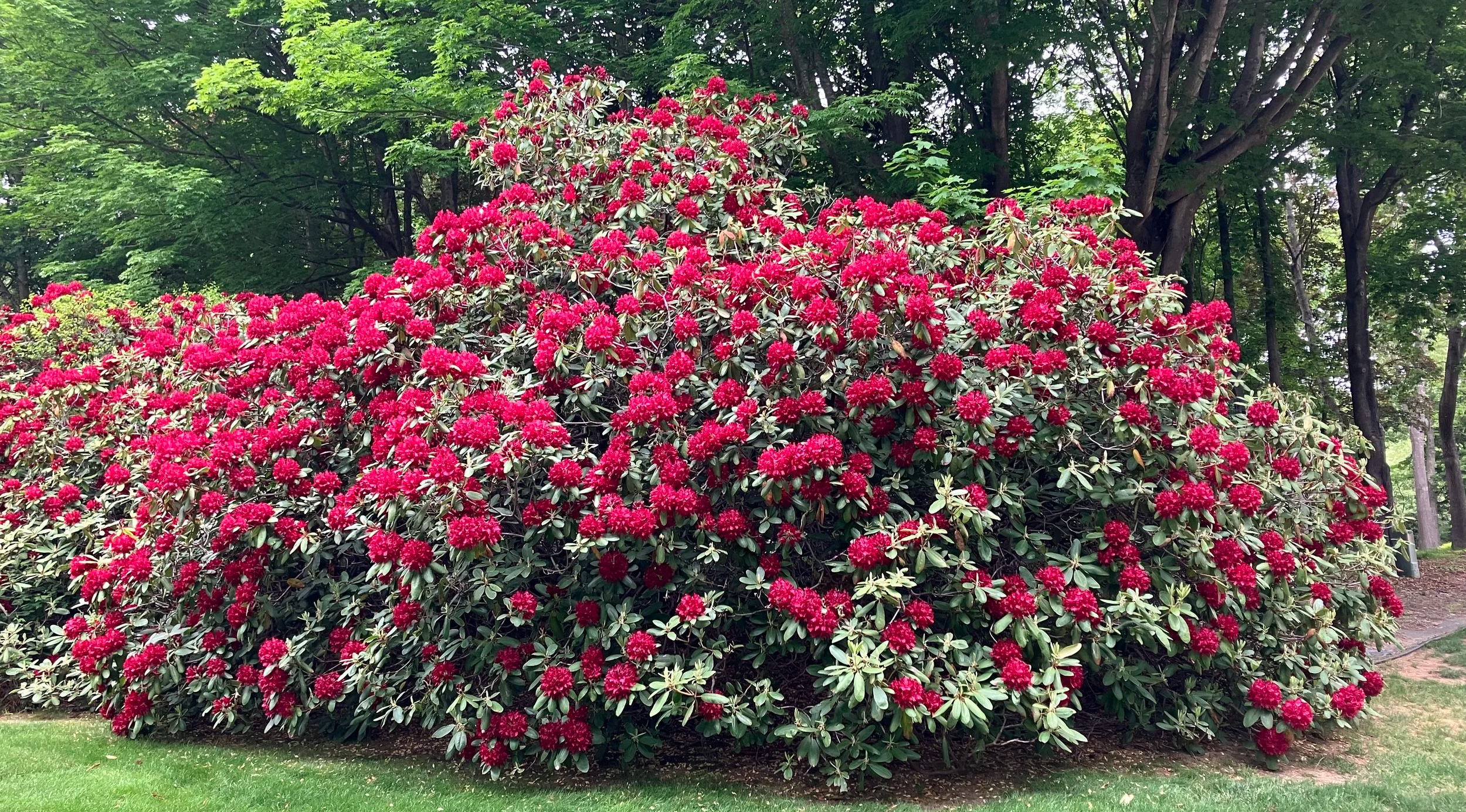
Beautiful ‘Francesca’ Blooming near the street.
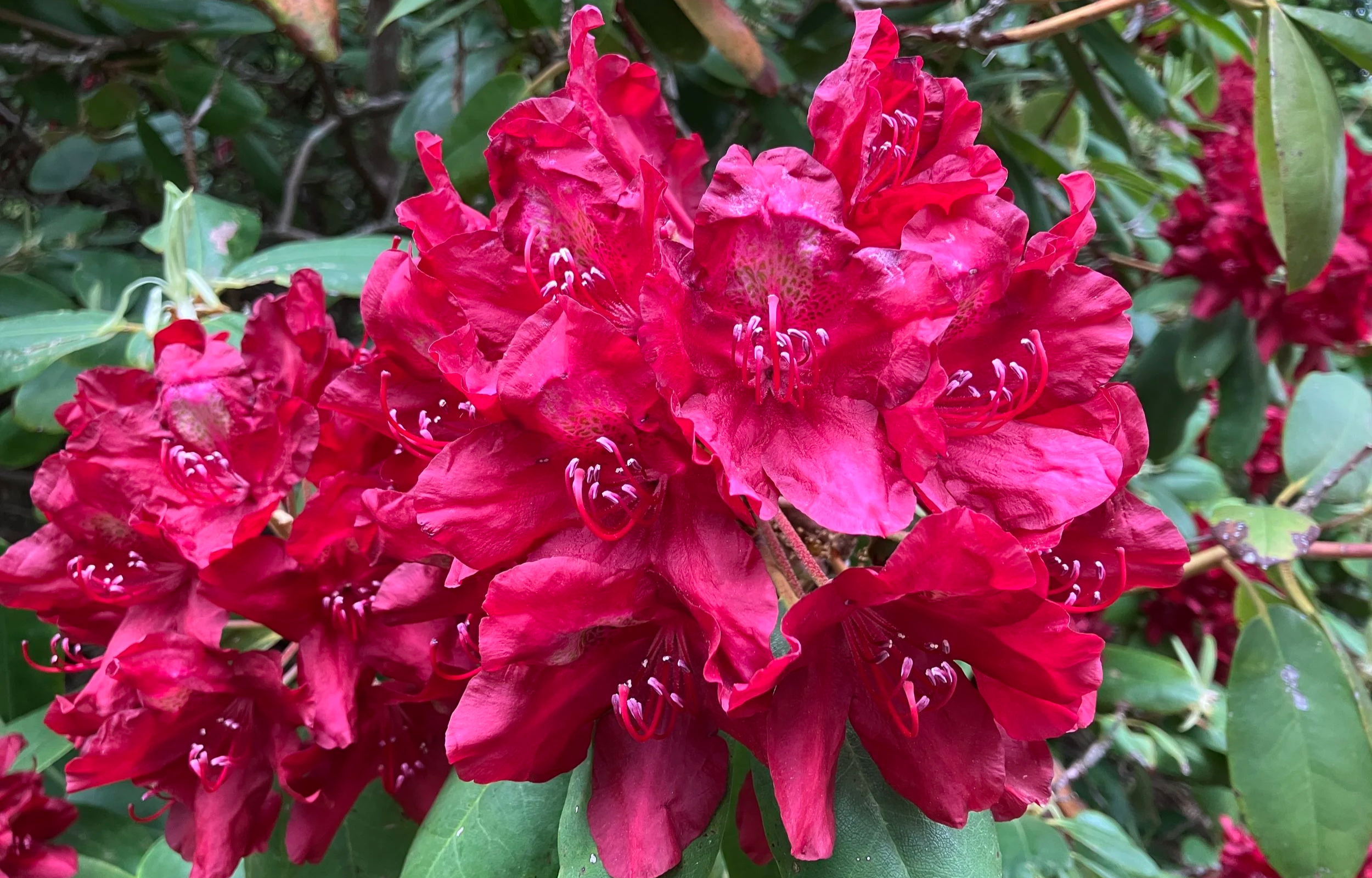
A close up shot of the spectacular red bloom of ‘Francesca’
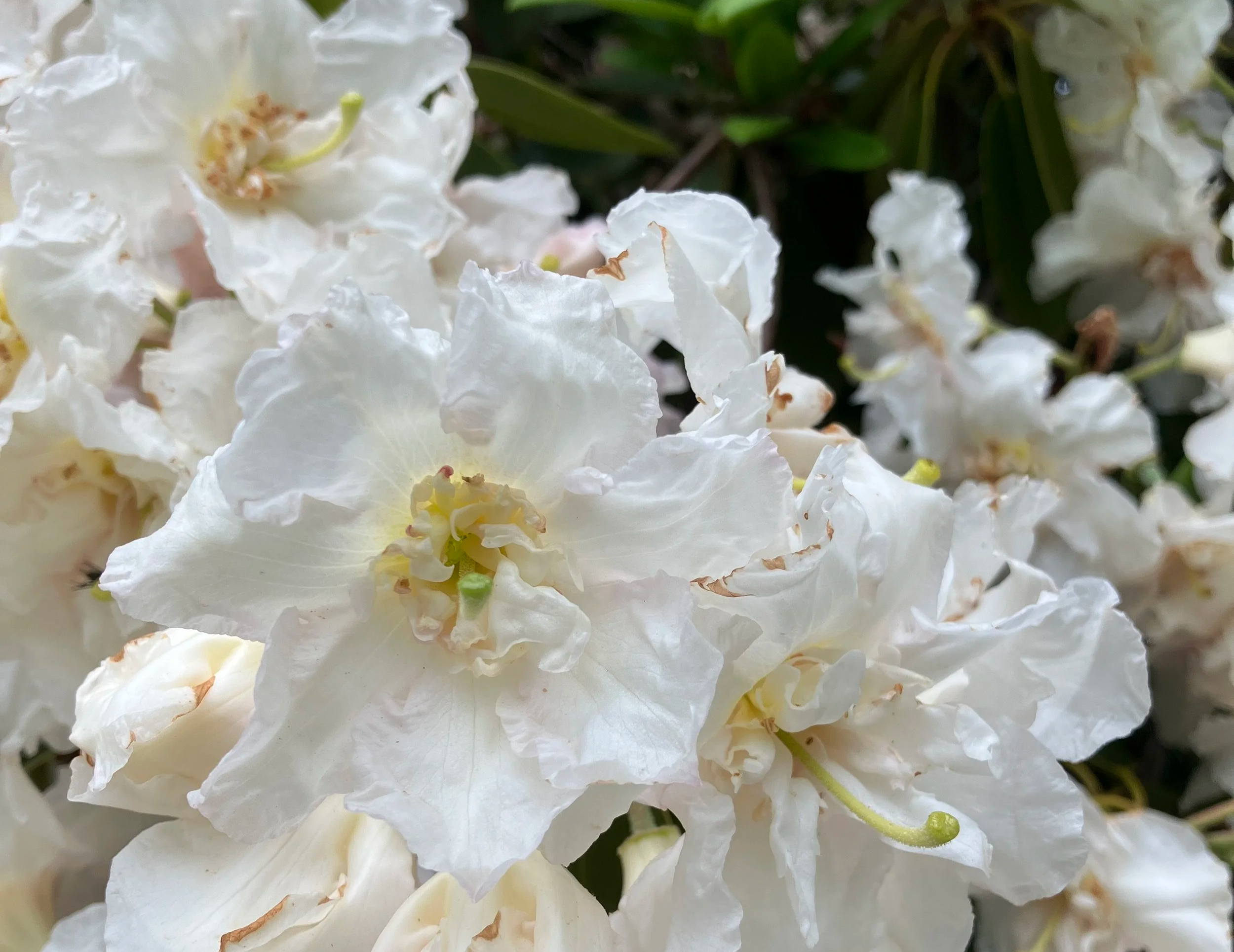
A white semi-double with nice fragrance mixed in the row of ‘Francesca’
- Final Comments -
NTC’s Nursery Manager, Abby Snoeren-place, took some beautiful photos of ‘Francesca’ blooming in our nursery when I was away from Newport. Her phone camera is far superior to my old clunker, and her photography skills are probably too. Since our plants from Forest Hills started their season in Oregon, the flowers came about 7-10 days before the plants in the landscape and were a luscious carmine-red color. The bloom was more sequential.
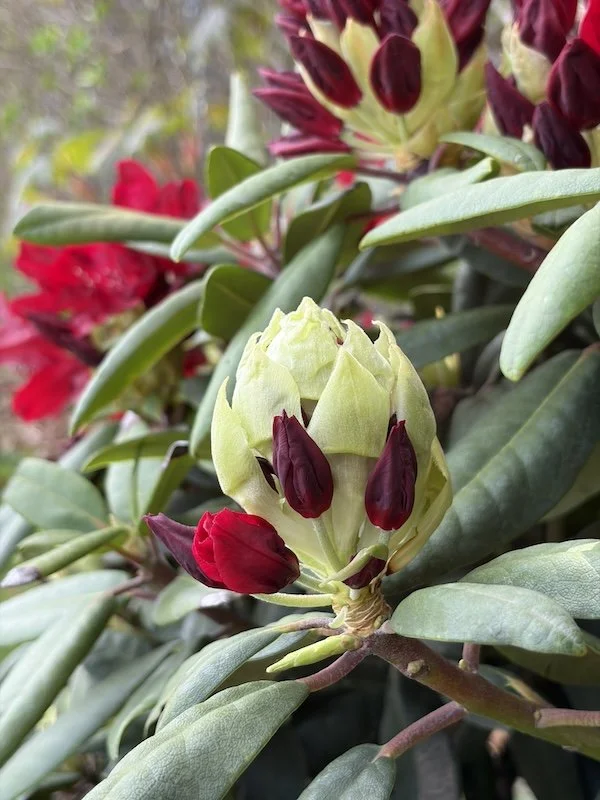
Photo Credit: Abby Snoeren: Place
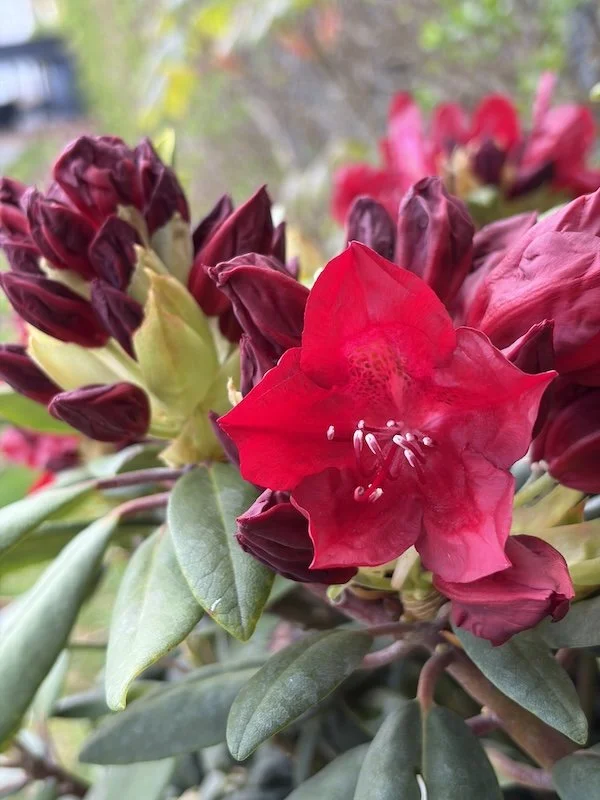
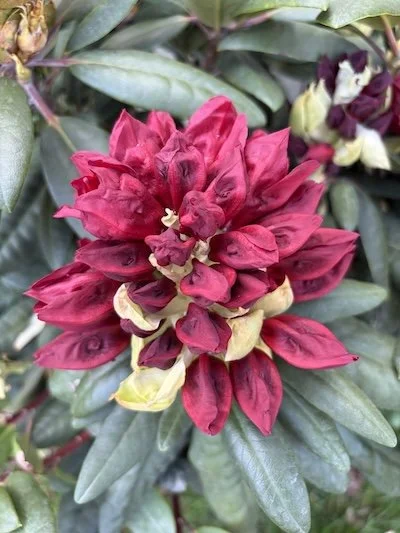
Photo Credit: Abby Snoeren Place
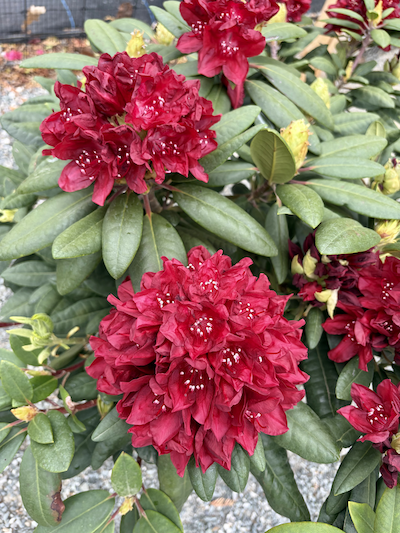
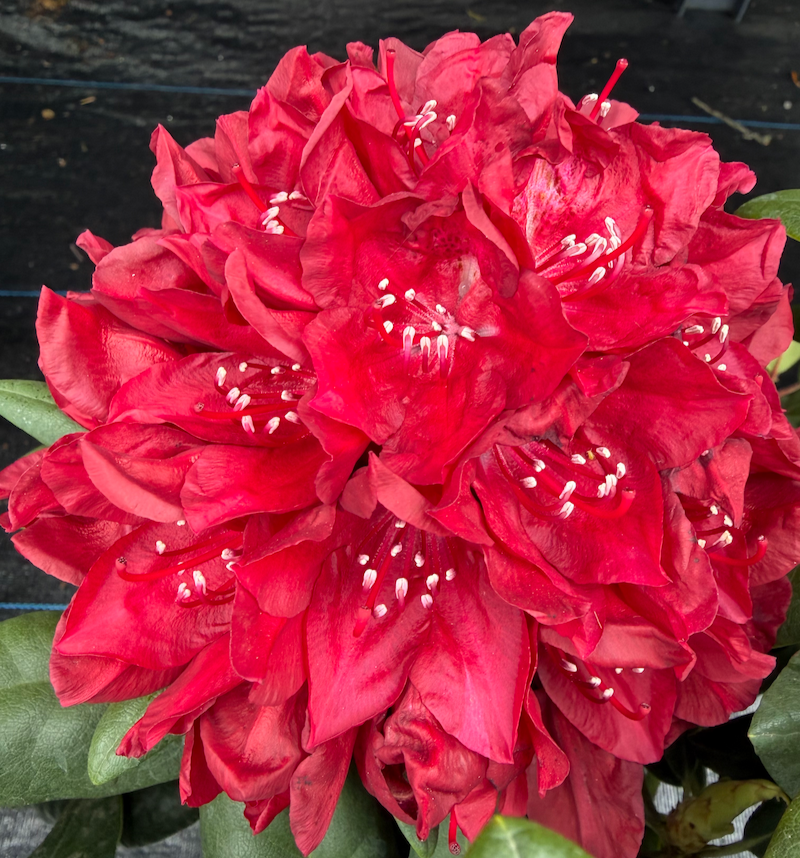
Photo Credit: Abby Snoeren-Place
Joe Verstandig – NTC Living Collections Manager
A special thank you to Bob Aube, Ronn St. Jean, Abby Snoeren-Place, and Sue Gordon.
References:
Summer Hill Nursery Inc. The Plants We Grow. 1995 Edition
Dirr, Micheal. Manual of Woody Landscape Plants. Stipes, 2009
Swift, Dorothy. Francesca Singing Tree Gardens Nursery. 2026 https://singtree.com/products/francesca?srsltid=AfmBOoq9UgFJanl4_wUOh5ckw5hWbD6X6UpKbNQhpxWqLRgvM7Nuy0MF
American Rhododendron Society.com Plant Search: Pioneer Silvery Pink 2026
American Rhododendron Society.com Plant Search: Francesca 2026
American Rhododendron Society.com Pant Search: Brittania 2026
Howard, Heman A. Dexter Rhododendrons: Their Past, Present, and Future. Quarterly Bulletin of the American Rhododendron Society. Vol. 26 1972
Heritage Museum and Gardens https://heritagemuseumsandgardens.org/
Leonard, Johnathan. A Breeder’s Perspective. Journal of the American Rhododendron Society. Vol. 47 1993