A Name That Traveled the World
Have you ever noticed how often the word cedar appears in common tree names? To understand why, we have to go back to the origins of modern plant naming and the work of Carl Linnaeus. In Species Plantarum (1753), he established the system of binomial nomenclature — a two-part, Latin-based naming system using genus and species. Within that system, the genus Cedrus was created, and to this day it includes only three species.
From that point forward, however, the word cedar began to take on a life of its own. It was gradually applied to other trees that shared certain characteristics, even if they were not true members of the genus Cedrus.
The name “cedar” originally referred to the Cedar of Lebanon. Because of its strong ties to Biblical stories, it remains the most famous cedar today, even though its wood is not as widely used as that of other trees now called “cedar.” Over time, many different trees were given the name because their wood had a similar fragrance, or because their leaves or bark resembled those of the original cedar. In some cases, the name helped market the wood. In others, there seems to have been no clear reason at all. As a result, the word cedar has come to describe trees that are entirely distinct in structure and growth habit, belonging to different families and originating from widely separated parts of the world.
The Original Cedar
When “cedar” appears in a common name, it is often being used as a historical or descriptive label rather than a strict botanical one. The only true cedars belong to the genus Cedrus, which is part of the pine family, Pinaceae. This small group includes three species: Cedrus libani (Cedar of Lebanon), Cedrus atlantica (Atlas cedar), and Cedrus deodara (Deodar cedar).
Cedar of Lebanon (Cedrus libani) – Towering and timeless, the Cedar of Lebanon has long symbolized strength and endurance. Its fragrant, durable wood was prized by ancient civilizations for building temples, palaces, and ships. Frequently mentioned in the Bible, it became the archetype of “cedar” throughout the Mediterranean world and beyond. Insert Cedar of Lebanon photo with caption to the right creating two columns
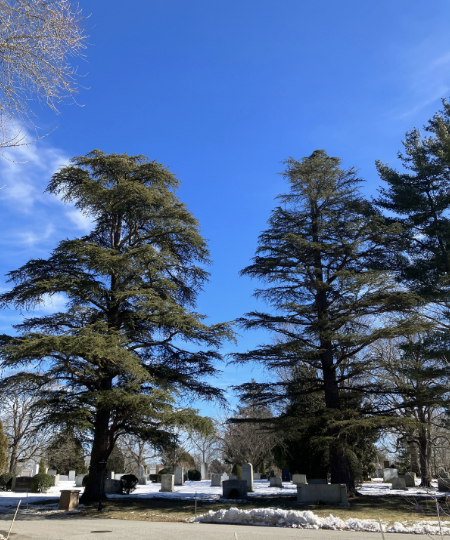
Cedar of Lebanon, showing massive columnar habit with broad horizontally tiered branches
Atlas cedar (C. atlantica) – Native to the mountains of North Africa, the Atlas cedar is broad and elegant, with silvery-green needles and a stately form. Its wood carries a rich, resinous aroma and has been valued for construction, decorative carving, and ceremonial uses. Certain botanical sources consider the Atlas cedar to be a subspecies of the Cedar of Lebanon which is written as Cedrus libani subsp. atlantica, but seems to be a source of contention in the horticulture world. Insert Atlas cedar photo with caption to the right creating two columns
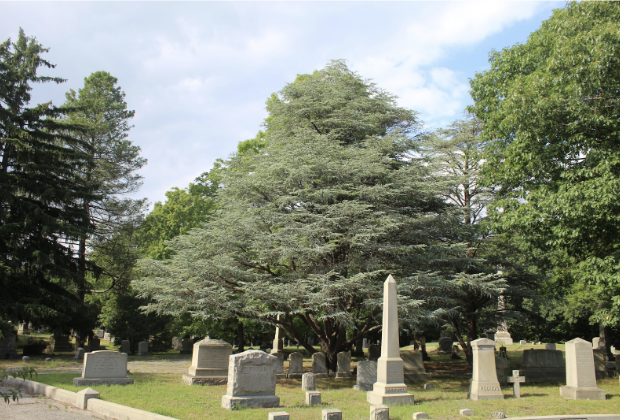
Blue Atlas cedar, a cultivar of the Atlas cedar with foliage that have a blue green hue
Deodar cedar (C. deodara) – Originating in the high Himalayas, the Deodar cedar is known for its graceful, drooping branches and softly aromatic wood. Its name means “timber of the gods,” reflecting its sacred status in Indian culture, where it has been planted near temples and monasteries for centuries. Insert Deodar cedar photo with caption to the right creating two columns
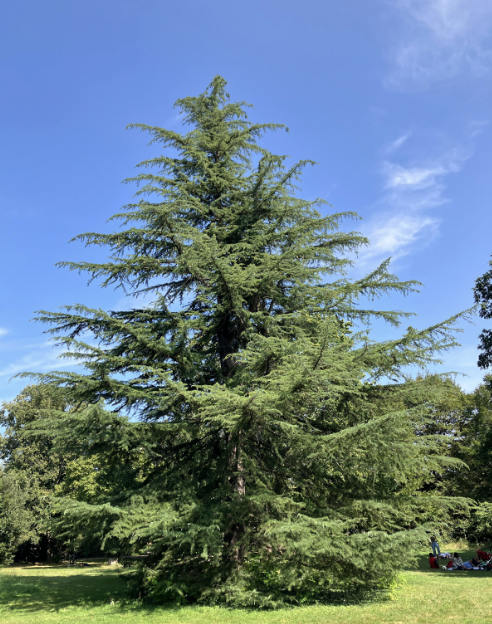
Deodar cedar, exhibiting pyramidal form when young with weeping or pendulous branches
How North America Got Its “Cedars”
Early European settlers in North America encountered unfamiliar conifers whose scent, wood, and foliage reminded them of the Old World cedars they already knew. These “false cedars” possessed aromatic oils and durable, rot-resistant wood that, at the time, seemed indistinguishable from the cedars of the Mediterranean and the Himalayas. Similar foliage texture and comparable wood performance reinforced the resemblance. Because settlers were already familiar with cedars from Europe and Asia, they reused the word “cedar” for trees that looked or functioned in much the same way.
Many of these American species appeared structurally and chemically similar in wood behavior to true cedars, and the lumber trade further reinforced the name. Associating these trees with “cedar” helped ensure demand for their durable, decay-resistant timber.
Most of the North American “false cedars” belong to the family Cupressaceae (the cypress family), which contains the largest number of species commonly called cedar. Other plant families around the world also include species with “cedar” in their common names.
Below are several notable examples, along with the products and uses that helped cement their association with true cedars accompanied with alternate names to portray their true lineage:
Thuja plicata (Western redcedar) - The Western Redcedar carries the cedar name largely because of its durability, fragrance, and cultural importance in the Pacific Northwest.
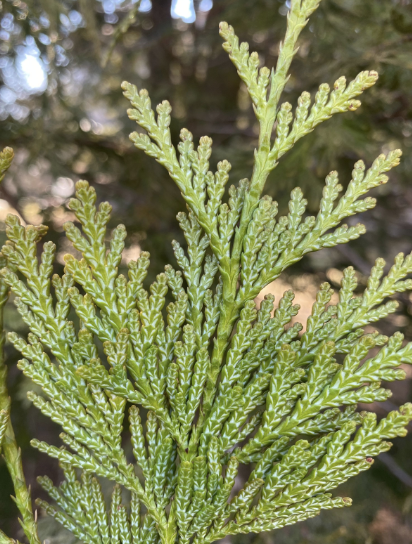
Western Redcedar is scale-like, dark green, with white butterfly markings on the underside, arranged in flat sprays
Shingles and Shakes
Utility Poles and Marine Timbers
Cedar Leaf Oil and Extracts
Alternate common name: Giant Arborvitae
Juniperus virginiana (Eastern redcedar) - Eastern redcedar’s identity as a “cedar” rests primarily on fragrance and specialty wood uses.
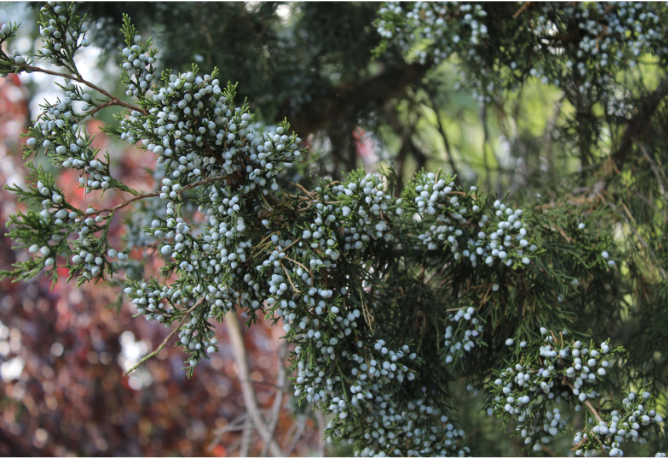
Eastern Redcedar has needle-like leaves on new growth that becomes scale-like with age arranged in alternating pairs along the twig, giving the twig a square or four-sided cross-section
Cedarwood Oil
Closet Linings and Chests
Christmas Trees
Alternate common names: Red Juniper, Virginian Juniper or Eastern Juniper
Cupressus nootkatensis, formerly Chamaecyparis nootkatensis (Nootka cedar) - Nootka cedar is valued for exceptional durability and workability, qualities long admired in true cedars.
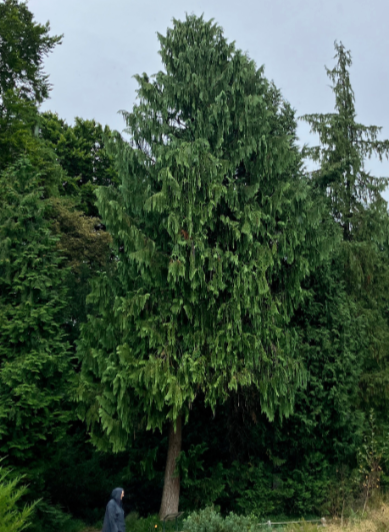
Nootka Cedar is a conical, evergreen, tree with scale-like leaves and often with striking foliage, hanging like curtains from the main branches. The bark changes from green to wine red and finally becomes brown and fibrous with stringy ridges that can be peeled away.
Boat Building and Marine Construction
Architectural and Structural Timbers
High Quality Export Logs
Alternate common name: Nootka cypress
Similar Wood, Different Family Tree
True cedars in the genus Cedrus are easily distinguished from the so-called false cedars of the cypress family. Species of Cedrus have long, stiff needles borne in dense clusters along the branches, giving them a tufted, spiky appearance. They also produce large, upright, barrel-shaped cones that sit vertically on the branches and break apart while still on the tree when mature.
In contrast, members of the cypress family — including Chamaecyparis (false cypress), Cupressus (true cypress), Juniperus (Juniper), and Thuja (Arborvitae) — bear scale-like foliage that lies flat against the twigs or forms soft, feathery sprays. Their cones are much smaller and remain intact at maturity; in junipers, they are even berry-like in appearance.
In short, true cedars have clustered needles and large, upright cones that disintegrate on the tree, while false cedars have scale-like foliage and small, persistent cones.
Does It Matter What We Call Them?
Lumping all these trees together under the name “cedar” can obscure important biological differences that directly affect management decisions in the field.
True cedars in the genus Cedrus belong to the pine family, Pinaceae. As a result, they behave more like pines and firs than like the trees many people casually call cedar. They share similar growth habits, wood structure, and disease patterns with other needle-bearing evergreens in that family.
By contrast, trees such as Thuja plicata (Western redcedar) and species of Juniperus belong to the cypress family, Cupressaceae. They contend with a different suite of insects and diseases and exhibit distinct growth strategies. Despite sharing the cedar name, they are not closely related to true cedars.
Wood structure differs significantly as well. Cedrus wood resembles that of other Pinaceae species — generally straight-grained and resinous — while many Cupressaceae species contain unique extractives and aromatic oils that influence decay resistance, scent, and milling characteristics. These chemical differences can affect everything from compartmentalization to how wood responds to pruning or wounding.
Root systems and crown architecture vary, too. True cedars often develop strong central leaders with broad, layered branching patterns. Many Cupressaceae “cedars,” however, display different crown densities and branching habits, and in some cases shallower or more fibrous root systems. These distinctions influence failure potential, wind resistance, and pruning strategy.
So the next time you’re out for a walk, take a closer look at those so-called cedars around you. You may be surprised how many “cedars” aren’t cedars at all. Once you know what to look for, those clustered needles and upright cones begin to feel like a quiet botanical handshake with the true ones. And the next time that familiar cedar scent catches your attention, pause and study the foliage and cones — a little curiosity can turn an ordinary walk into a small act of discovery.
— Jonathan Dietz , NTC Field Arborist
Bibliography
Adams, Robert P. 1987. “Investigation of Juniperus Species of the United States for New Sources of Cedarwood Oil.” Economic Botany 41 (1): 48–54.
Adams, Robert P. 1991. “Cedar Wood Oil: Analyses and Properties.” Modern Methods of Plant Analysis 12: 159–173.
Chalchat, J. C., R. P. Garry, A. Michet, and B. Benjilali. 1994. “Essential Oil Components in Sawdust of Cedrus atlantica from Morocco.” Journal of Essential Oil Research 6 (3): 323–325.
Dallimore, W. 1913. “Cedar Woods.” Bulletin of Miscellaneous Information (Royal Botanic Gardens, Kew), no. 6: 207–224.https://doi.org/10.2307/4115007.
Demetci, E. Y. 1986. Toros Sediri (Cedrus libani A. Richard) Odununun Bazı Fiziksel ve Mekanik Özellikleri Üzerine Araştırmalar [Studies on the Some Physical and Mechanical Properties of Cedar (Cedrus libani A. Richard) Wood]. Teknik Bülten Serisi 180. Ormancılık Araştırma Enstitüsü Yayınları.
Dirr, Michael A. 1990. Manual of Woody Landscape Plants: Their Identification, Ornamental Characteristics, Culture, Propagation, and Uses. Champaign, IL: Stipes Publishing Company.
Harris, A. S. 1971. Alaska-Cedar. American Woods FS-224. Washington, DC: USDA Forest Service.
Lawson, Edwin R. 1985. Eastern Redcedar—An American Wood. FS-260. Washington, DC: USDA Forest Service.
Maheshwari, P., and C. Biswas. 1970. Cedrus. Botanical Monograph 5. New Delhi: Council of Scientific and Industrial Research.
Perry, R. S. 1954. Yellow Cedar: Its Characteristics, Properties, and Uses. Bulletin 114. Ottawa: Canada Department of Northern Affairs and Natural Resources, Forestry Branch.
Smith, J. H. G., and D. S. DeBell. 1973. “Opportunities for Short Rotation Culture and Complete Utilization of Seven Northwestern Tree Species.” Forestry Chronicle 49 (1): 31–34.
Tewari, D. N. 1994. A Monograph on Deodar (Cedrus deodara (Roxb.) G. Don). Dehra Dun, India: International Book Distributors.
Traité des Arbres et Arbustes. 1755. Vol. 1: 139. Nom. cons.