
The Mystery Fir of Newport
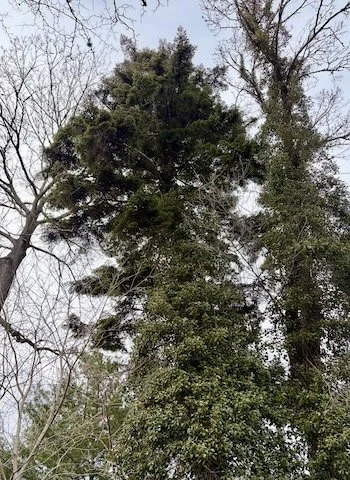
“I have a towering conifer on my Newport property that no arborist has been able to identify to date,” was an email I received from a local Newport resident during my first month at NTC. Not exactly the kind of message you expect on a normal workday, but definitely one that gets your attention. At first, it sounded like an exciting mystery until Joe Verstandig, the NTC Living Collections Manager, informed me I would be the one tasked with solving it.
Going into it, we at least knew the genus: Abies, commonly known as the true firs. Photographs sent ahead of our visit were enough to narrow it down to the genus, but the species remained unknown. Most people are familiar with firs, even if they don't realize it. While they are not the most common trees found in the landscape, they are probably best known as some of the most popular Christmas trees. Fraser fir, Noble fir, and Douglas fir are among the most popular Christmas trees grown and sold in the United States. They are extremely cold hardy trees that thrive in climates where temperatures regularly fall well below 0°F. I've often wondered why firs aren't as popular as other conifers, such as arborvitae, pines, or even spruces, whether for screening or as a striking specimen in Rhode Island landscapes. While they tolerate our winters with ease, many fir species are less adapted to the heat and humidity of southern New England, making them less commonly planted despite their beauty.
When we pulled up to the location, pole pruners in hand, it quickly became clear we were going to need to return with a very large ladder. This was no ordinary landscape tree. At first glance, there wasn't much we could make out, just a massive trunk cloaked in English ivy (Hedera helix), rising well above us. At roughly 70 feet tall, dense ivy obscured much of the lower canopy, leaving the finer details impossible to discern.
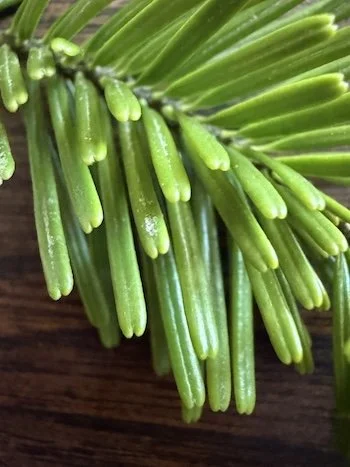
We managed to collect samples from what we could reach, along with a small piece of broken bark before heading out. Cone samples would have made identification much easier, but finding an intact fir cone on the ground is a rare sight. True firs hold their cones perfectly upright on their uppermost branches and are often a striking bluish-purple or olive-green color before they mature. They slowly disintegrate while still attached to the tree, scattering their seeds to the wind and leaving behind a long, upright central spike. This distinctive feature helps set firs apart from the drooping, downward hanging cones of spruces and pines that fall to the ground completely intact. Firs are also characterized by their relatively short, soft needles, which typically end in a blunt point and attach directly to the twig. Unlike spruces, whose needles leave behind small, peg-like projections (sterigmata) when they fall, fir needles detach cleanly and leave the twig smooth.
I went home that Friday with our samples and a few conifer keys, but I felt stumped all weekend. I kept circling two possibilities: Nordmann fir (A. nordmanniana) or Veitch fir (A. veitchii), but which one? Both are valued for their classic pyramidal growth habit, dark green foliage, and tiered branches that flow to the ground. The Nordmann fir is native to the temperate regions of the Caucasus Mountains and northeastern Turkey, where its range forms a crescent along the eastern end of the Black Sea through Georgia, Armenia, Russia, and Turkey. Named after the Finnish-born botanist Alexander von Nordmann, it was introduced to Europe in the mid-19th century and can reach over 200 feet in the wild. Native to Japan, the Veitch fir was discovered on the slopes of Mount Fuji in 1860 by the British horticulturist and plant collector John Gould Veitch, one of the earliest Victorian plant hunters to explore Japan, who later introduced the species to Western cultivation. In the end, it would take one small, easily overlooked feature to separate the two.
By Monday morning, even after combing through conifer keys and reference materials, I still couldn't confidently choose between the two species. A different approach was needed. Having learned about both species the previous spring in Brian Maynard's Landscape Plants class at URI, I decided to revisit the very trees I had originally studied. Before returning to the office, I collected two additional twig samples on campus, one from each suspected species, to compare alongside those from the mystery tree.
Comparing the samples side by side changed everything. Suddenly the picture became much clearer, and the defining characteristics of our mystery fir began to stand out. The tapering needles and distinct bifurcated (notched) needle tips said it all. A tree that had stumped many others before me could finally be given a name: Abies veitchii, the Japanese native Veitch fir.
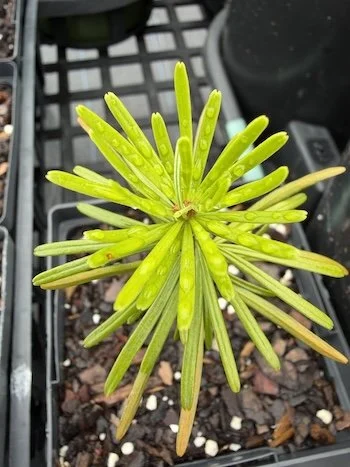
Karen was kind enough to let us dig up a few seedlings from the property, which are now growing at NTC's Heritage Tree Nursery. They'll be cared for and propagated so future generations of arborists can get stumped all over again. Needless to say, this was a memorable first project at the Newport Tree Conservancy, and it still feels a little surreal to call this my job.
Abby Snoeren-Place - Nursery Production Manager
Works Cited
Abies. iNaturalist, https://www.inaturalist.org/taxa/54262-Abies. Accessed 7 July 2026.
Abies (Fir). American Conifer Society, https://conifersociety.org/conifers/abies. Accessed 7 July 2026.
Farjon, Aljos. Abies veitchii. Conifers.org, https://conifers.org/pi/Abies_veitchii.php. Accessed 7 July 2026.
Fir Trees (Abies). Bomengids, https://www.bomengids.nl/uk/fir-trees.html. Accessed 7 July 2026.
Plant Database: Abies veitchii. University of Connecticut, https://plantdatabase.uconn.edu/detail.php?pid=7. Accessed 7 July 2026.
Veitch, John Gould. “Abies veitchii.” Transactions of the Royal Horticultural Society of London, vol. 6, 1866, pp. 71–73. Biodiversity Heritage Library, https://www.biodiversitylibrary.org/page/19683009#page/80/mode/1up. Accessed 7 July 2026.